Amazon FBA China: The Complete Sourcing Guide for 2026
 Hidayat Khan·Jul 2026·12 min read
Almost every Amazon seller who messages me is somewhere in the same journey, just at a different point. Some are still looking for a factory. Some have a supplier and no idea whether to trust them. Some have stock sitting at a port because nobody labeled it. The steps are the same for everyone, and the ones people skip are almost always the ones that cost money later.
This is the whole route on one page, from the Guangzhou side. Seven stages, what actually happens at each, what it costs you in time and money, and where the 2026 rule changes bite. Each stage links out to a deeper guide if you want the detail, so treat this as the map and those as the close-ups.
What does sourcing from China for Amazon FBA actually involve?
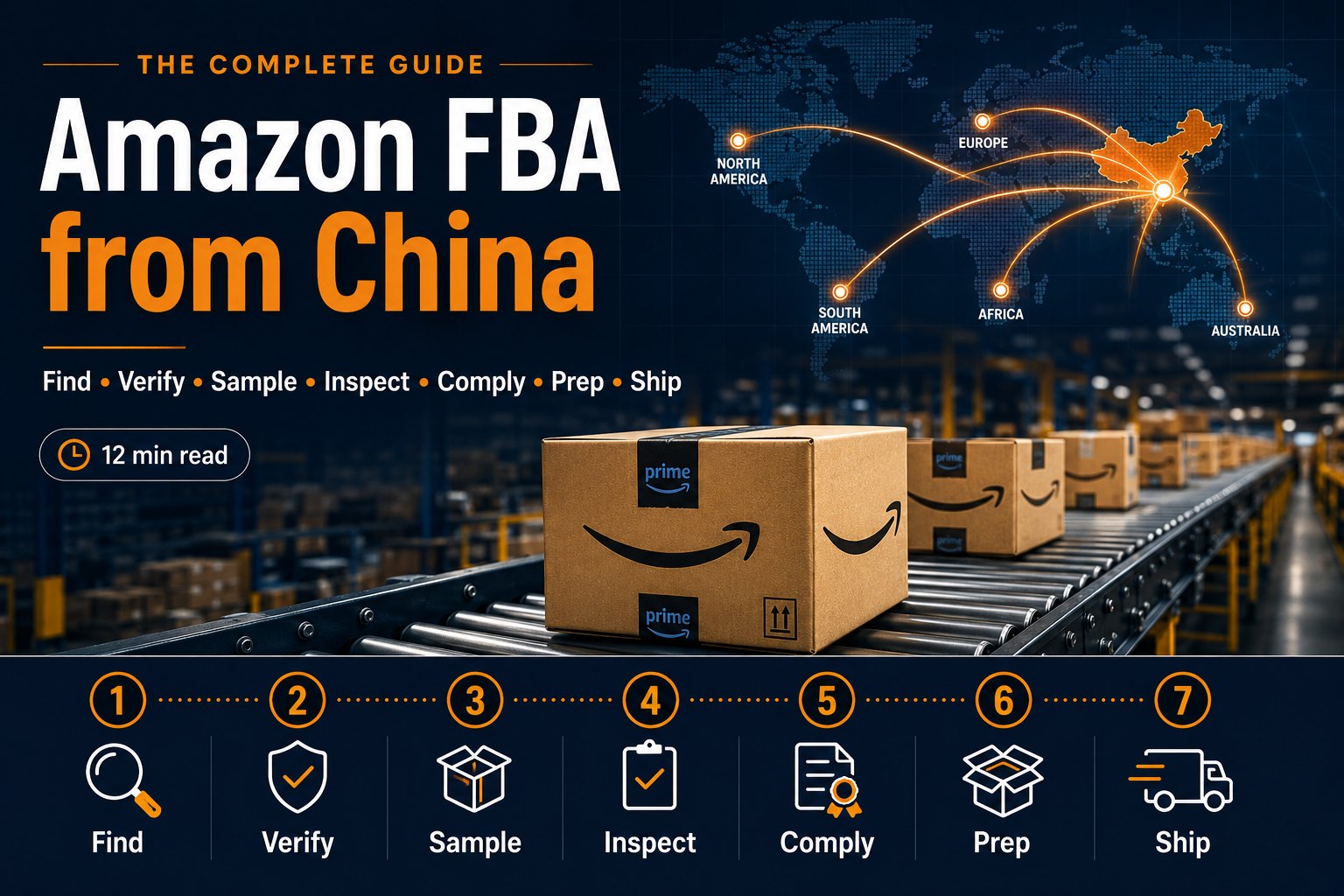
Seven stages, in this order. Skipping one rarely saves time, it just moves the problem later in the chain where fixing it is more expensive.
Stage 1: Finding a supplier
Three routes, and most sellers eventually use more than one. Alibaba is built for export and English-speaking buyers, so it is the natural starting point, though many listings are trading companies rather than factories. 1688 is the domestic Chinese platform where prices are lower, but it is Chinese-only, uses domestic payment, and offers no export service, which is why it generally needs someone in China acting for you. Trade fairs are the third route, and meeting factories in person compresses months of messaging into a few days, which is why I still work the Canton Fair every spring and autumn.
AI tools have made the early filtering much faster, and I use them daily to normalise a messy list of suppliers into something comparable. They just cannot walk a factory floor, which is the part that decides whether the supplier is real. I wrote about that balance in using AI for supplier research.
Stage 2: Verifying before you pay
This is the stage that protects everything after it, and the one most first-time sellers rush. A supplier profile is a claim, not evidence. Before any deposit moves, the company's business licence should be checked on China's official registry, the scope of business should match what they claim to make, and the factory photos should not reverse-image-search to somebody else's website.
The full protocols live in three guides: verifying a supplier before payment, verifying the factory before you wire a deposit, and avoiding supplier-switching scams. If you read only one thing before sending money, read those.
Every problem I get called in to fix late traces back to a check that was skipped early. Verification is the cheapest stage in the whole chain.
Stage 3: Samples, MOQ and price
Never order a container of something you have not held. Samples cost a little and shipping them costs more than people expect, but they answer questions no photo can. This is also where you negotiate minimum order quantity, and where a lot of sellers overcommit. Testing a product with a small batch first, then scaling once you have real sales data, is almost always the cheaper path: see small MOQ product testing.
One warning on price. The lowest quote is rarely the lowest cost. A supplier can hit a target price by thinning the packaging, swapping a material, or leaving compliance testing out of scope, and you find out at the destination.
Stage 4: Compliance and certificates
Compliance is legally yours, not the factory's. As the importer of record you hold the obligation, and Amazon can ask you for documentation at any time. The certificates suppliers volunteer are often reused from another product or self-declared, which is why the document has to match your exact model, standard and market.
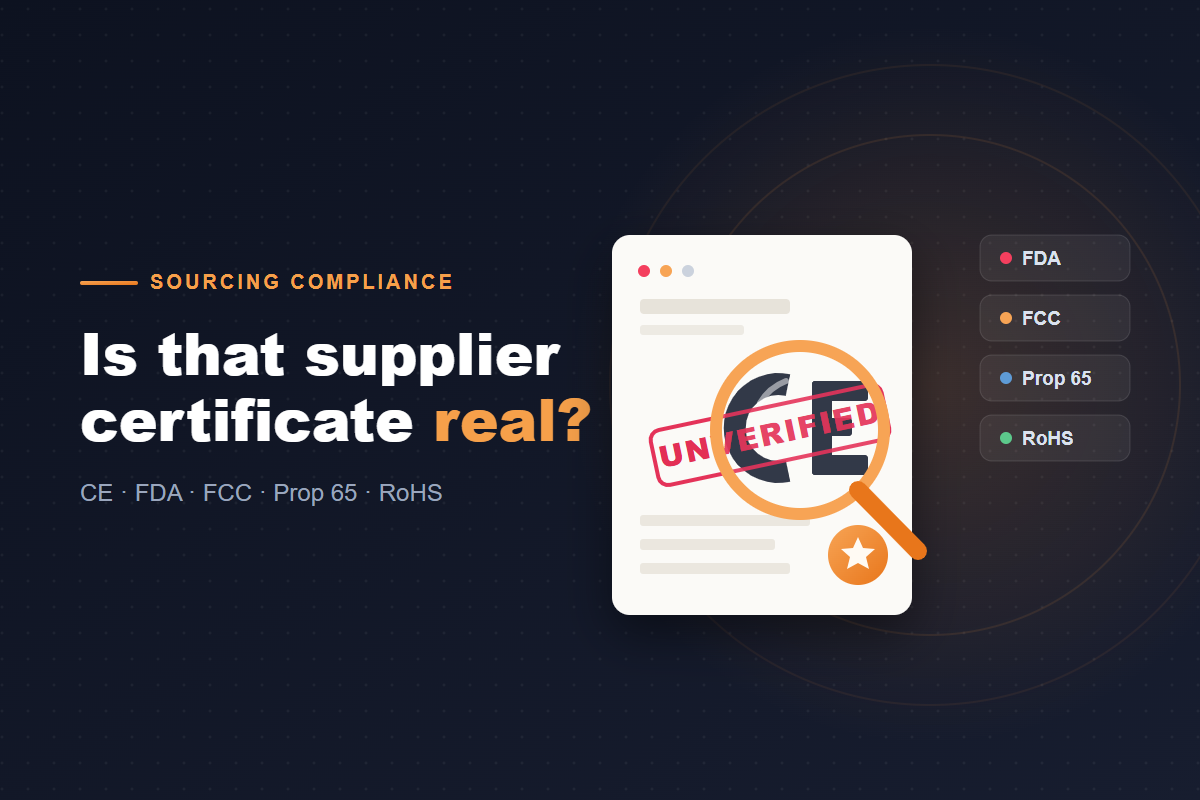
Which certifications apply depends entirely on your product and destination: FCC for US electronics, CE and UKCA in Europe and the UK, CPC and ASTM for children's products, FDA for food-contact items, Prop 65 in California. The full walkthrough, including how I check whether a certificate is genuine, is in is your supplier's CE or FDA certificate real.
Stage 5: Production and inspection
Production usually runs three to five weeks depending on category and season. The critical moment is the end of it: a pre-shipment inspection while the goods are still in the factory, before the container is sealed. Once goods are on the water, a defect stops being a rework problem and becomes a returns problem, and on Amazon that means refunds and review damage.
Inspect against a written specification, not a vague standard, and have the inspector confirm packaging and labeling at the same visit. The mistakes I see most often are collected in QC inspection mistakes to avoid before shipment.
Stage 6: Prep and labeling (the 2026 change)
This is the stage that changed, and it catches people out. From 1 January 2026, Amazon no longer offers prep and item-labeling services for FBA shipments in the US store. The FNSKU labeling and packaging compliance that Amazon used to handle for a fee must now be done before your goods arrive, which in practice means at the factory or a third-party warehouse.
The factory is usually the cheapest place to do it, because the units are already open and being packed. Get it wrong and cartons get refused at the fulfilment centre, which is exactly how launches slip. Details and the full checklist are in the guide to shipping from China to Amazon FBA.
Stage 7: Shipping, duty and landed cost
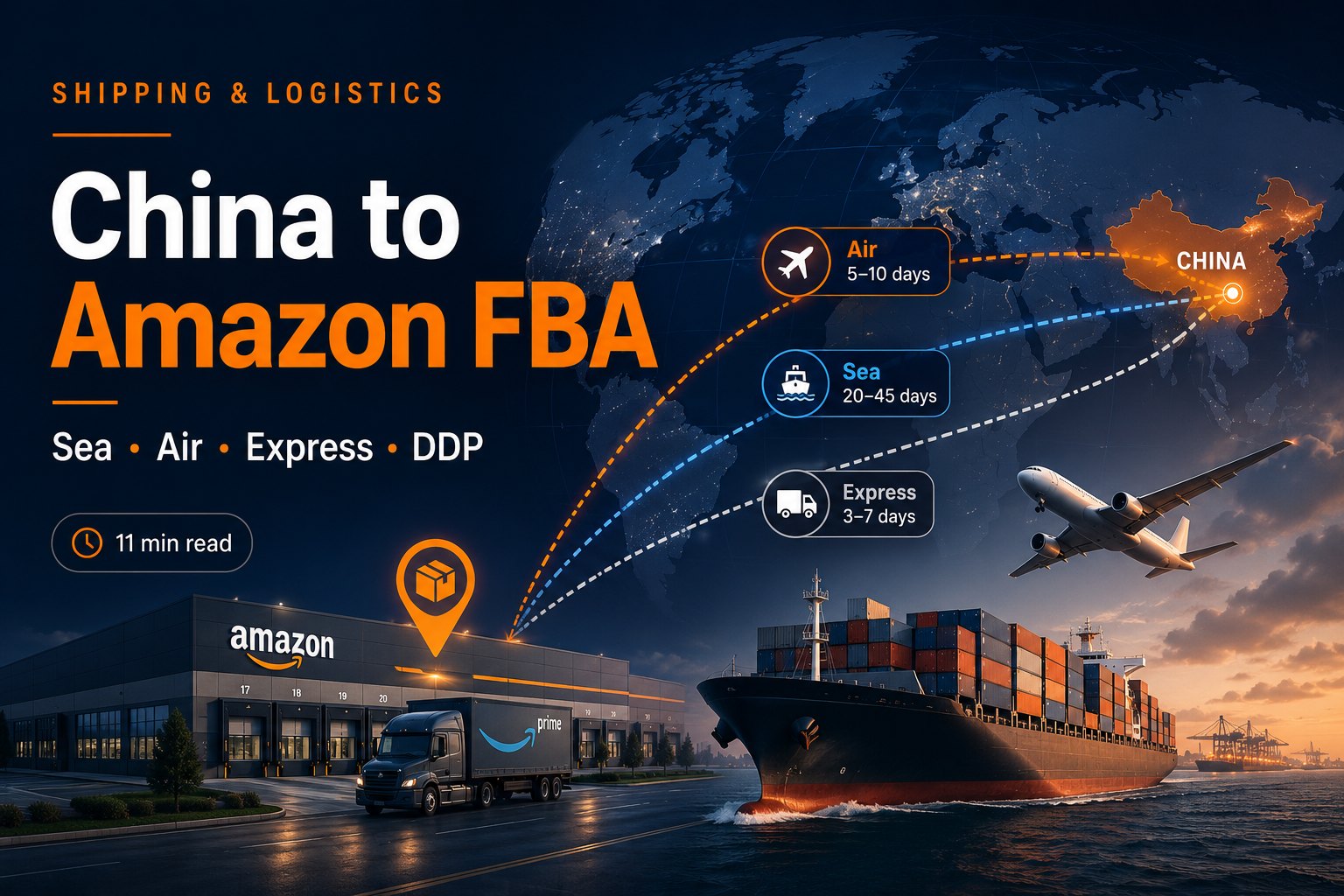
Air for a launch, sea to scale. Express courier moves in days and costs the most, air freight takes about 5 to 10 days, and sea runs roughly 30 to 45 days door to fulfilment centre. The Incoterm you agree decides where the supplier's responsibility ends: FOB is the clean default, and a cheap DDP quote can hide an under-declared customs value that lands on you as importer of record. See DDP, DAP, FOB and EXW explained, and the glossary of shipping and trade terms if the acronyms are new.
Then the number that actually decides whether this product makes money: landed cost. Unit price, samples, testing, inspection, freight, duty and tariff, labeling and prep, Amazon's inbound placement fee, and storage. These extras routinely add 30 to 40 percent on top of the factory quote. Build the whole stack before you commit, using the real landed cost checklist, and check how tariffs are changing the maths in 2026.
How long does the whole thing take?
Budget three to four months for a first order. Reorders are much faster, because sourcing, sampling and compliance are already behind you. The two things that blow the timeline are Chinese New Year and the Q4 peak, so plan backwards from those.
If your launch has to hit a date, work backwards from it and add a buffer, especially across January and February. My guide to preparing your supply chain before Chinese New Year covers how far ahead to order.
Do you need a sourcing agent?
Honest answer: not always. If you have a verified supplier, a simple product with no complex compliance, and time to manage the back and forth, you can run this yourself. Plenty of sellers do.
An agent earns their fee at the specific points where being in China matters: standing in the factory, negotiating in Chinese, reaching 1688 suppliers, consolidating samples, running the pre-shipment inspection, and getting FNSKU labeling done on the production line. Whether that is worth paying for is a maths question, and I published my actual rates so you can do the maths: what a China sourcing agent really costs.
Frequently asked questions
How do I find a supplier in China for Amazon FBA?
Most sellers start on Alibaba, which is built for export and English-speaking buyers. 1688 is the domestic Chinese platform with lower prices but no export service, Chinese-only listings, and domestic payment, so it usually needs an agent. Trade fairs like the Canton Fair let you meet factories in person. Whichever route you use, treat every listing as a claim until you verify the company is a real manufacturer.
How long does it take to get products from China into Amazon FBA?
Budget roughly 3 to 4 months for a first order. Finding and verifying a supplier takes 2 to 3 weeks, samples another 2 to 3 weeks, production typically 3 to 5 weeks, then inspection and prep, then shipping of about 5 to 10 days by air or 30 to 45 days by sea. Reorders are faster because sourcing and sampling are already done.
Do I need a sourcing agent for Amazon FBA, or can I do it myself?
You can do it yourself if you have time, a verified supplier, and a product with no complex compliance. An agent earns their fee when you need factory verification on the ground, Chinese-language negotiation, access to 1688, sample consolidation, pre-shipment inspection, or FNSKU labeling arranged at the factory. Compare the fee against the cost of one bad order.
What changed for Amazon FBA prep in 2026?
From 1 January 2026, Amazon no longer offers prep and item-labeling services for FBA shipments in the US store. FNSKU labels, poly bagging and packaging compliance now have to be completed before the goods reach Amazon, which in practice means at the Chinese factory or a third-party warehouse. Confirm who is doing it before production finishes.
What does it cost to source a product from China for Amazon FBA?
Beyond the unit price, budget for samples and shipping, lab testing and certification, a pre-shipment inspection, freight, customs duty and any tariff, FNSKU labeling and prep, and Amazon's inbound placement fee. These extras routinely add 30 to 40 percent on top of the factory quote, which is why landed cost, not unit price, is the number that matters.
Key takeaways
- Seven stages: find, verify, sample, comply, produce and inspect, prep and label, ship. Skipping one moves the cost later, it does not remove it.
- Verification is the cheapest stage and protects every stage after it. A supplier profile is a claim, not evidence.
- Compliance is legally yours as importer of record, not the factory's, and Amazon can ask for the documents at any time.
- Since January 2026 Amazon no longer does FBA prep or item labeling in the US store. FNSKU labeling now happens at the factory or a 3PL.
- Plan 3 to 4 months for a first order, and judge the product on landed cost, not unit price. Extras often add 30 to 40 percent.
Sourcing your first FBA product from China?
Tell me the product and your target market. I will map the route, tell you honestly whether it is worth sourcing, and quote the stages you actually need. Based in Guangzhou, on the factory floor.
Start your FBA sourcing