How Much Does a Sourcing Agent in China Actually Cost? (Real 2026 Prices)
 Hidayat Khan·Jun 2026·9 min read·Last reviewed Jun 2026
Client stories in this article are based on real projects. Names, exact amounts and identifying details have been adjusted for confidentiality.
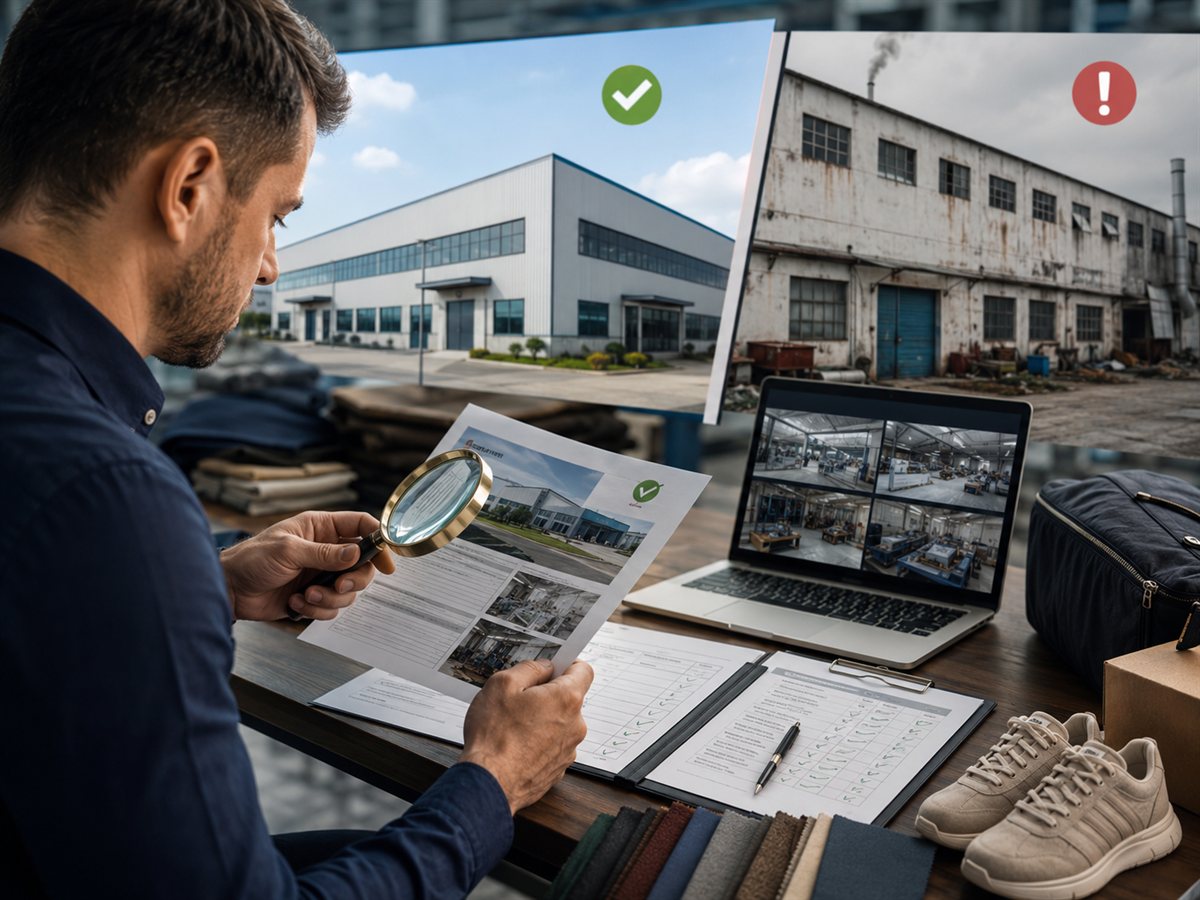
Last month a client reached out after hiring a 15 dollar online sourcing agent. The agent had sent him a beautiful supplier profile from Yiwu. Glossy product photos, low quotes, friendly English. The client was 48 hours from wiring a 7,000 dollar deposit when he booked a 30 minute consultation call with me for 50 dollars. We pulled the supplier's business license off GSXT together. It was registered as a trading enterprise, not a manufacturer. The product photos on its Alibaba page had been lifted from a different factory's website. The deposit did not leave his account.
A different client, different story. He decided to skip the agent entirely and source his product himself through Alibaba. He got scammed for 2,500 dollars. The supplier disappeared after the deposit. No product, no answer, no refund. He messaged me afterwards asking how to recover the money. The honest answer was: you cannot.
This is the cost question every importer eventually asks me. How much should I actually pay a sourcing agent in China? And underneath it, the harder question: is it worth paying anything at all? Let me walk you through what the real fees look like in 2026, what each fee should include, and the trap that catches people who shop on price alone.
Why sourcing-agent pricing is so confusing
The market has three problems. First, most agents do not publish their fees on a public page. Second, the ones who do publish often quote a low headline number and add hidden margins later. Third, a buyer without sourcing experience cannot tell the difference between an honest 380 dollar flat fee and a "free" agent who is quietly taking 12 percent from the factory side.
The common pattern looks like this. An agent on Fiverr or Upwork offers "free supplier sourcing" or charges 15 to 30 dollars for a "supplier list". The agent makes the real money through kickbacks. The factory adds 5 to 15 percent on top of its real quote because it has to pay the agent's share. The buyer thinks they are getting a deal. They are getting an agent who works for the factory, not for them. And every quote they receive is silently inflated.
The fix is not to find the cheapest agent. It is to find an agent who tells you exactly how they make money on your order.
The four ways China sourcing agents actually charge in 2026
Honest agents use one of four models, or a mix of them. Here is what each one looks like in practice.
1. Flat per-project fee
A fixed price for a fixed scope. The buyer knows what they will pay before any work starts. The agent knows exactly what is in scope. The factory has nothing to do with the fee. Typical ranges I see across the market in 2026:
- Supplier sourcing + verification: 300 to 2,000 dollars per project, depending on category complexity.
- Consultation call: 50 to 150 dollars per 30 to 60 minutes.
- Factory visit + audit: 200 to 500 dollars per factory, location-dependent.
- Pre-shipment quality inspection: 200 to 400 dollars per inspection (third party services like AsiaInspection sit in this range too).
- Full A-to-Z first-order setup: 1,000 to 3,000 dollars bundled.
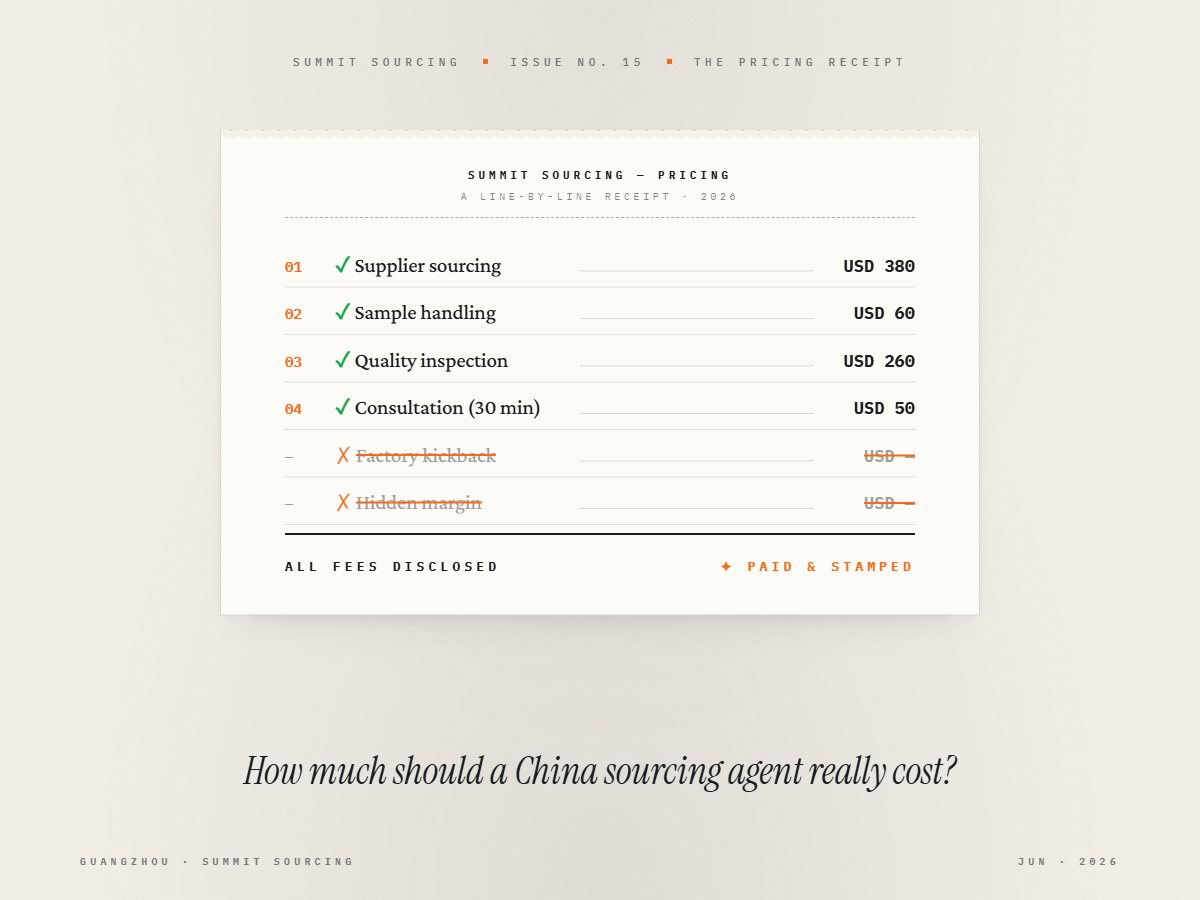
For reference, this is exactly how I price at Summit Sourcing. My flat rates: 380 dollars for sourcing (3 to 5 vetted suppliers, full transparency report), 60 dollars for sample testing and consolidation per round, 260 dollars per pre-shipment quality inspection, and 50 dollars for a 30 minute consultation call. No commission on top. No factory side fee. What you see is what you pay.
2. Commission percentage of order value
The agent takes a percentage of the total order value as their fee. This is also legitimate, as long as the percentage is disclosed and paid by the buyer directly. Typical ranges:
- Standard: 5 to 10 percent of order value.
- High volume: 3 to 5 percent on large or repeat orders.
- Small or complex: 10 to 15 percent on small one-off orders or technical sourcing.
I offer 5 percent on full order or container value as an alternative to my flat fee if a client prefers commission. This usually makes sense when the order is large enough that 5 percent comes in close to or below the flat sourcing fee plus inspections. The upside of commission is that the agent has skin in the game on every order. The downside is the incentive misalignment, because the agent earns more on bigger orders and could push you to higher quantities than you actually need.
3. Monthly retainer (a fixed salary)
A monthly fee for ongoing supplier management. Suited to brands with 10 or more active SKUs across multiple suppliers, or constant new product development. Typical ranges:
- Part-time portfolio support: 1,500 to 2,500 dollars per month.
- Dedicated full-time agent: 3,500 to 5,000 dollars per month.
I offer this on scope to established brands. It works out cheaper than per-project fees once the workload is steady. Think of it as having a procurement team in Guangzhou on call, without setting up an entity in China yourself.
4. Hourly consulting (rare)
An hourly rate for ad-hoc advice without ongoing engagement. Typical ranges: 50 to 150 dollars per hour. Useful when you handle most of the sourcing yourself and only need help on specific decisions. My 50 dollar consultation call fits this model. Buyers use it most often to sanity check a supplier they have already shortlisted before they wire the deposit.
The 15-dollar agent trap
Now back to the client I opened with. The agent he hired on a freelance platform charged 15 dollars for "supplier shortlist with verified manufacturers". The agent sent over a Yiwu trader. The agent's real income came from a side deal with that trader, who paid him a small fee for every buyer he sent.
A 15 dollar sourcing fee almost cost my client his 7,000 dollar deposit. A 50 dollar consultation saved it. The cheap agent was the most expensive part of his trip.
Three things gave away the trader. First, the company name on the business license ended in "Trading Co.", not "Manufacturing Co." or a factory-style name. Second, the registered scope of business included "wholesale and retail trade" with no production capacity. Third, the photos on the Alibaba page reverse-image-searched to a different factory in a different province. The buyer had not done any of these checks because the 15 dollar agent told him the supplier was "verified".
The 2,500 dollar self-sourcing scam followed a similar pattern. The buyer found a supplier on Alibaba, wired a 30 percent deposit, and got ghosted. The supplier's storefront had been live for three weeks and the company was registered in name only. No checks. No video walkthrough. No samples. Just a deposit gone.
Neither client was naive. Both were experienced business owners. The trap is not stupidity. The trap is that "save money on the agent" sounds responsible until you understand what the agent's real job is.
What a fair flat-fee sourcing engagement actually includes
When you pay 380 dollars for a sourcing project (or any honest flat fee in this range), here is what the work actually is. I will use my own engagement as the example since the numbers are public on my contact page and on this article. Other agents charging similar fees should be doing similar work.
- Brief and category research. A short call or written brief to understand the product, target market, target price, target MOQ and certifications you need.
- Wide sourcing. 30 to 50 candidate suppliers pulled from Alibaba, 1688, Made-in-China and offline databases (factory directories, trade fair contact lists, industry referrals).
- Vetting. Business license verification on GSXT (China's official enterprise registry), production capacity check, product portfolio match, MOQ and pricing discussion, certification check (CE, FCC, RoHS, FDA as relevant).
- Shortlist. 3 to 5 candidates delivered in a detailed Google Sheets report. Specs, FOB prices, MOQs, lead times, certifications, photos, contact details, plus my honest pros and cons for each.
- Direct introductions. Communication on your behalf in Chinese to get past the language gate and clarify the technical questions that would otherwise stall by email.
- Negotiation support. Help shaping the first quote into something closer to the real factory price.
What is intentionally not included in the flat sourcing fee:
- Sample collection and consolidation (60 dollars per round).
- Pre-shipment quality inspection (260 dollars per inspection).
- Freight booking and customs prep (separate scope, quoted on volume).
This is intentional. Bundling everything into one flat fee makes small order buyers overpay and big order buyers underpay. Separating the fees lets each service stand on its own. You only pay for the part you actually need.
The one thing that decides if an agent is fair
Disclosure. Not the rate. The disclosure.
A 10 percent commission agent who tells you exactly how they make money is cheaper than a 5 percent agent who hides side payments. A 400 dollar flat-fee agent who shows you the supplier's business license is cheaper than a "free" agent who steers you to a friend's factory.
When you are evaluating any agent, the only question that really matters is this:
Walk me through exactly how you make money from my engagement. Show me each fee, where it comes from, and who pays it.
A fair agent will answer in plain language with specific numbers in under two minutes. They will tell you what they charge, whether they take anything from the factory side (most honest agents do not), and how they expect to be paid. If the agent dodges, gestures vaguely about "we handle everything", or gets defensive about the question, you have your answer. Walk away and find someone else.
How the 15-dollar client's story actually ended
After the consultation call, the client and I ran a proper sourcing engagement. 380 dollars flat. I pulled three real factories in the Shenzhen area, sent the detailed Google Sheets report on a Friday, and we did a 20 minute video walkthrough of his preferred factory the following Tuesday before any deposit went out. He paid 60 dollars for sample consolidation, then 260 dollars for the pre-shipment quality inspection when the first production run was ready.
Total he paid me across the whole first order: 380 plus 60 plus 260 equals 700 dollars. His first production run was just over 30,000 dollars FOB. The 700 dollars was 2.3 percent of the order value, fully transparent, no factory-side fees, no surprises. The product shipped on time and arrived to spec. He is now on his third reorder with the same factory and pays me 260 dollars per pre-shipment inspection each run. The 50 dollar consultation call paid for itself a hundred times over.
The 2,500 dollar self-sourcing client did not have such a clean ending. He absorbed the loss as a tuition fee, came back six months later, and we restarted from a proper supplier vetting. His new factory is in Foshan. The second time around, the deposit went to a real factory with a real business license and a real video walkthrough. No drama. Just orders.
Frequently asked questions
Why don't most sourcing agents in China publish their fees?
Many of them earn through kickbacks from the factories they introduce, not direct fees from buyers. When the buyer does not see a bill, they assume the service is cheap or free. The agent collects 5 to 15 percent from the factory side, the factory builds that into the quote, and the buyer ends up paying anyway, just without knowing.
Is 10 percent commission too much for a China sourcing agent?
It depends what is included. Ten percent with full sourcing, ongoing supplier management, sample handling and QC follow-through for a high-mix portfolio can be fair. Ten percent with just an Alibaba introduction and no follow-through is not. The number alone tells you nothing.
Do I pay the sourcing agent or the factory separately?
Separately. The agent fee goes to the agent. The product cost goes to the factory. If an agent insists on routing the factory payment through them, treat that as a red flag and ask why.
What if my order is too small to justify a sourcing agent?
Try a paid consultation first. I run a 30 minute call for 50 dollars and will tell you honestly whether your order makes sense to source through an agent, to source direct, or to buy through a wholesale platform like Alibaba Trade Assurance. Sometimes the right answer is your volume is too small, here is how to handle it yourself for now, message me again when your reorders grow.
Can a sourcing agent's rate be negotiated?
My flat rates are not negotiable. What is negotiable is the structure. If you prefer commission instead of a flat sourcing fee, I offer 5 percent on full order or container value as an alternative. For brands with ongoing volume, a monthly retainer can work out cheaper than per-project fees.
How much does Summit Sourcing actually charge in 2026?
Sourcing: 380 USD flat. Includes 3 to 5 vetted suppliers, business license cross-check on GSXT, and a detailed Google Sheets report with full pricing transparency. Sample testing and consolidation: 60 USD per round. Pre-shipment quality inspection: 260 USD per inspection. Consultation: 50 USD for 30 minutes. Alternative: 5 percent commission on full order or container value instead of the flat sourcing fee. Monthly retainer available on scope for brands with ongoing volume.
Key takeaways
- China sourcing agents in 2026 use one of four models: flat per-project fee, commission percentage, monthly retainer or hourly consulting. "Free service" usually means kickback from the factory.
- Real ranges: flat fees 300 to 2,000 dollars per scope, commissions 5 to 10 percent of order value, retainers 1,500 to 5,000 dollars per month, consulting 50 to 150 dollars per hour.
- The 15 dollar agent is usually the most expensive route. Saving money on the agent typically costs more on the order itself, through inflated quotes and bad supplier matches.
- Pay separately: agent fee to the agent, product cost to the factory. Never route product payments through the agent.
- The one question that decides fair from unfair: ask the agent to walk you through exactly how they make money on your order. A fair agent answers in under two minutes with specific numbers.
Want a transparent sourcing quote?
Flat 380 USD for sourcing, 60 for sample handling, 260 for pre-shipment QC. Full Google Sheets report, business license cross-check, no kickbacks. Tell me what you need and I will quote in one message.
Send your sourcing brief