China Importing Glossary: 25 Shipping & Trade Terms Explained
 Hidayat Khan·Jul 2026·10 min read
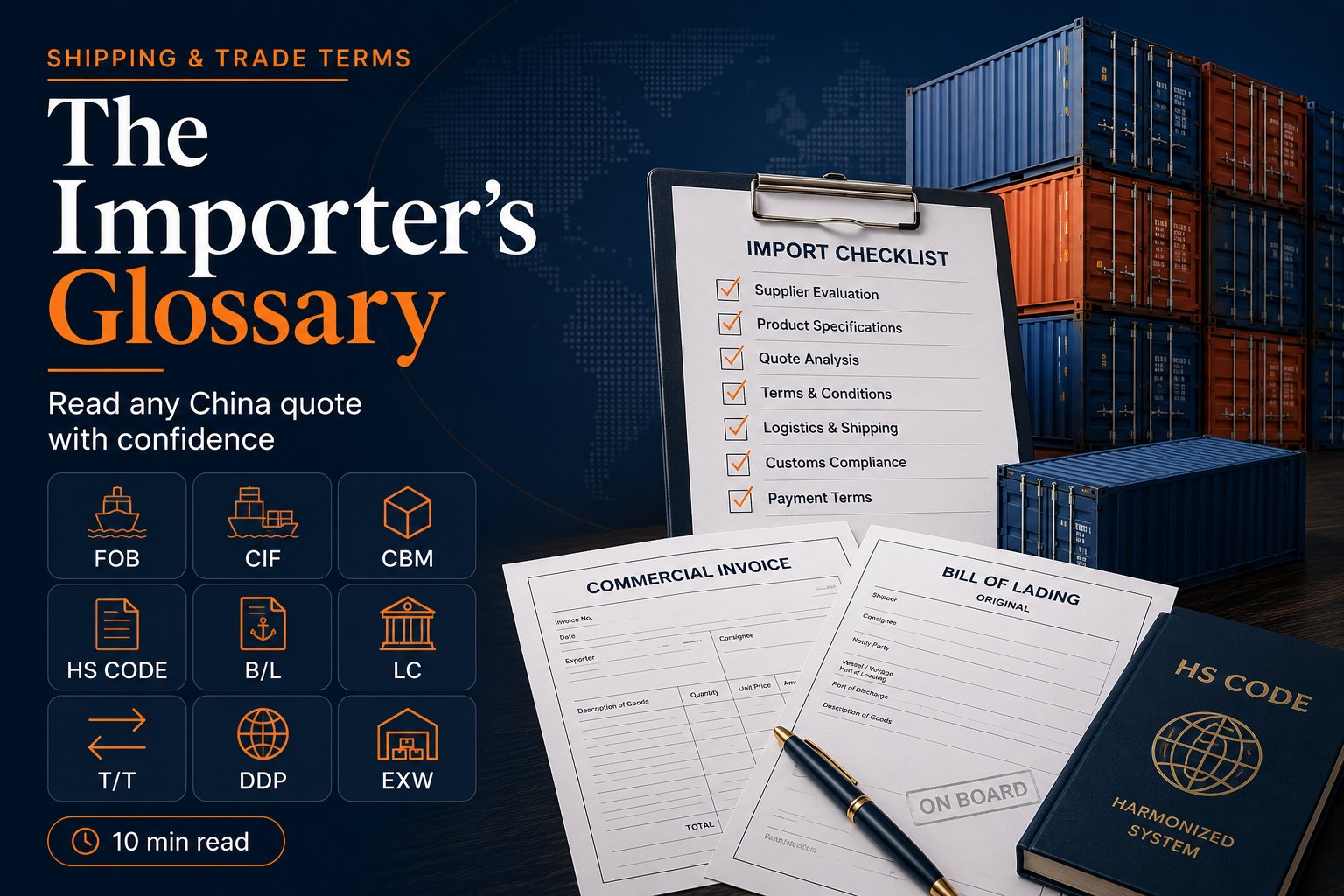
The first supplier quote a new importer sends me is usually followed by a second message: "what does half of this mean?" FOB, CBM, T/T, HS code, a bill of lading. The trade runs on a wall of acronyms, and suppliers rarely stop to explain them, because to them the words are obvious. To a first-time buyer they are a fog, and a fog is where mistakes and overcharges hide.
So this is the reference I send clients: the terms you will actually meet when you buy from China, grouped by where they show up, in plain English. Bookmark it and pull it up the next time a quote or a forwarder's email leaves you guessing. I will keep the Incoterms short here and point you to the deep dive, since those deserve their own explanation.
Incoterms: who pays, and who carries the risk?
Incoterms are the three-letter codes that decide where the supplier's responsibility ends and yours begins along the shipping journey. The whole thing comes down to one question: how far along the route does the seller's cost and risk reach? This strip shows the four you will see most.
EXW Ex Works
You collect from the factory door and handle everything after, including export clearance. Most control, most work.
FOB Free On Board
Supplier gets the goods onto the ship at the China port; you run it from there. The clean default for most importers.
CIF Cost, Insurance, Freight
Supplier pays freight and insurance to your destination port. You still handle import clearance and the final leg.
DDP Delivered Duty Paid
Supplier or forwarder delivers to your door with duty paid. Convenient, but a cheap quote can hide an under-declared value.
That is the summary. Which term to actually choose, and the traps inside DDP, are worth their own read: DDP, DAP, FOB and EXW explained.
The documents you'll see, and when
A shipment generates a small stack of paperwork, and each document appears at a predictable moment. Knowing which is which stops you from paying against the wrong one or panicking when a forwarder asks for something.
Proforma Invoice PI
The supplier's formal quote and order confirmation. You pay the deposit against it, so check quantities, price, and terms carefully.
Commercial Invoice
The final invoice customs uses to value your goods and calculate duty. It must match what is actually in the boxes.
Packing List
A carton-by-carton breakdown of quantities, weights, and dimensions. Your forwarder and customs both rely on it.
Bill of Lading B/L
The carrier's contract and title document. Whoever holds the original controls release of the goods, which is why final payment often ties to it.
Certificate of Origin CO
States where the goods were made. It can change your duty rate under trade agreements, so it is worth getting right.
Container and volume terms (how freight is priced)
This is the group that surprises people on their first invoice. Freight is not priced on weight alone. A big, light shipment can cost more than a small, heavy one, because carriers charge on whichever is greater: your actual weight or the space you take up.
LCL Less than Container Load
Your goods share a container with other shippers. Right for smaller loads, priced by CBM.
FCL Full Container Load
You book a whole 20ft or 40ft container. Cheaper per unit once you have roughly 15 CBM or more to fill it.
CBM Cubic Meter
Volume: length × width × height in metres. The main unit sea freight is priced on for smaller loads.
Chargeable Weight
The figure you are actually billed on: the greater of real weight or volumetric weight. Bulky-light goods lose here.
Gross vs Net Weight
Gross weight is product plus all packaging; net weight is the product alone. Quotes and customs forms will ask for both.
How you'll pay
These decide how money moves to the supplier. The right term protects you as much as it pays them. Whichever you use, verify the company first, because payment terms do not matter if the supplier is not real. My guide to verifying a supplier before you pay covers that side.
T/T Telegraphic Transfer
A standard bank wire, the most common method. Usually paired with a 30/70 split.
30/70 Deposit
30 percent to start production, 70 percent before the goods ship or against the B/L. Never pay 100 percent up front.
L/C Letter of Credit
Your bank guarantees payment once the supplier meets documented conditions. Slower and costlier, used on larger orders.
Trade Assurance
Alibaba's on-platform protection that holds funds until you confirm the order was met. Only covers orders kept on Alibaba.
Customs and cost terms
The last group is where a shipment meets your government, and where surprise charges live. Two of these, demurrage and drayage, are the ones that quietly appear on a final bill and make people ask what they just paid for.
HS / HTS Code
The classification number that sets your duty rate. The wrong code means overpaying, or an under-payment customs corrects with penalties.
Duty / Tariff
The tax on imported goods, based on the HS code and declared value. See how tariffs are reshaping costs.
Customs Bond
A guarantee that duties will be paid, required for US commercial imports above a value threshold. Single-entry or annual.
Demurrage
Penalty charges when your container sits at the port past its free time. Clear customs promptly to avoid it.
Drayage
The short-haul trucking of a container from the port to a warehouse or rail yard. A real line item people forget to budget for, alongside the rest of your landed cost.
Frequently asked questions
What does FOB mean when importing from China?
FOB stands for Free On Board. The supplier is responsible for the goods and all costs until they are loaded onto the ship at the Chinese port, and you take over from there, including sea freight, insurance, and import clearance. FOB is the cleanest default for most importers because it draws a clear line at the port and lets you control the shipping side.
What is CBM in shipping?
CBM means cubic meter, the volume of your shipment calculated as length times width times height in metres. Sea freight for smaller loads is often priced per CBM, so a bulky but light product can cost more to ship than a small heavy one. Always give your forwarder both the CBM and the weight so they can quote correctly.
What is the difference between LCL and FCL?
LCL means Less than Container Load, where your goods share a container with other shippers, and it suits smaller orders. FCL means Full Container Load, where you book an entire 20-foot or 40-foot container to yourself. FCL is usually cheaper per unit once you have enough volume to fill most of the container, roughly 15 CBM or more.
What is an HS code and why does it matter?
An HS code, or Harmonised System code, is the international classification number for your product that decides the duty and tariff rate you pay at customs. The wrong code can mean overpaying duty, or an under-payment that customs corrects later with penalties. Confirm the correct code for your exact product before you ship, not after.
What does a 30/70 payment term mean with Chinese suppliers?
It means you pay a 30 percent deposit to start production and the remaining 70 percent before the goods leave the factory, usually against a copy of the bill of lading or after a passed inspection. It is the most common term for a first order. Never pay 100 percent up front, and verify the supplier before any money moves.
Key takeaways
- Incoterms answer one question: how far along the journey the supplier's cost and risk reach. FOB is the clean default for most importers.
- Each document has a moment: proforma invoice at order, commercial invoice and packing list at production, bill of lading at shipping.
- Freight is billed on chargeable weight, the greater of actual weight or volume. Bulky, light products get charged on CBM.
- Pay with T/T on a 30/70 split for most first orders. Never pay 100 percent up front, and verify the supplier first.
- Watch the customs group: the right HS code sets your duty, and demurrage and drayage are the surprise charges people forget.
Staring at a quote full of acronyms?
Forward it to me. I will translate every line into plain English, tell you what is fair, and flag anything that looks off, before you commit a deposit.
Send me your quote