Visiting China for the First Time: The 2026 Setup Guide
 Hidayat Khan·Jul 2026·14 min read
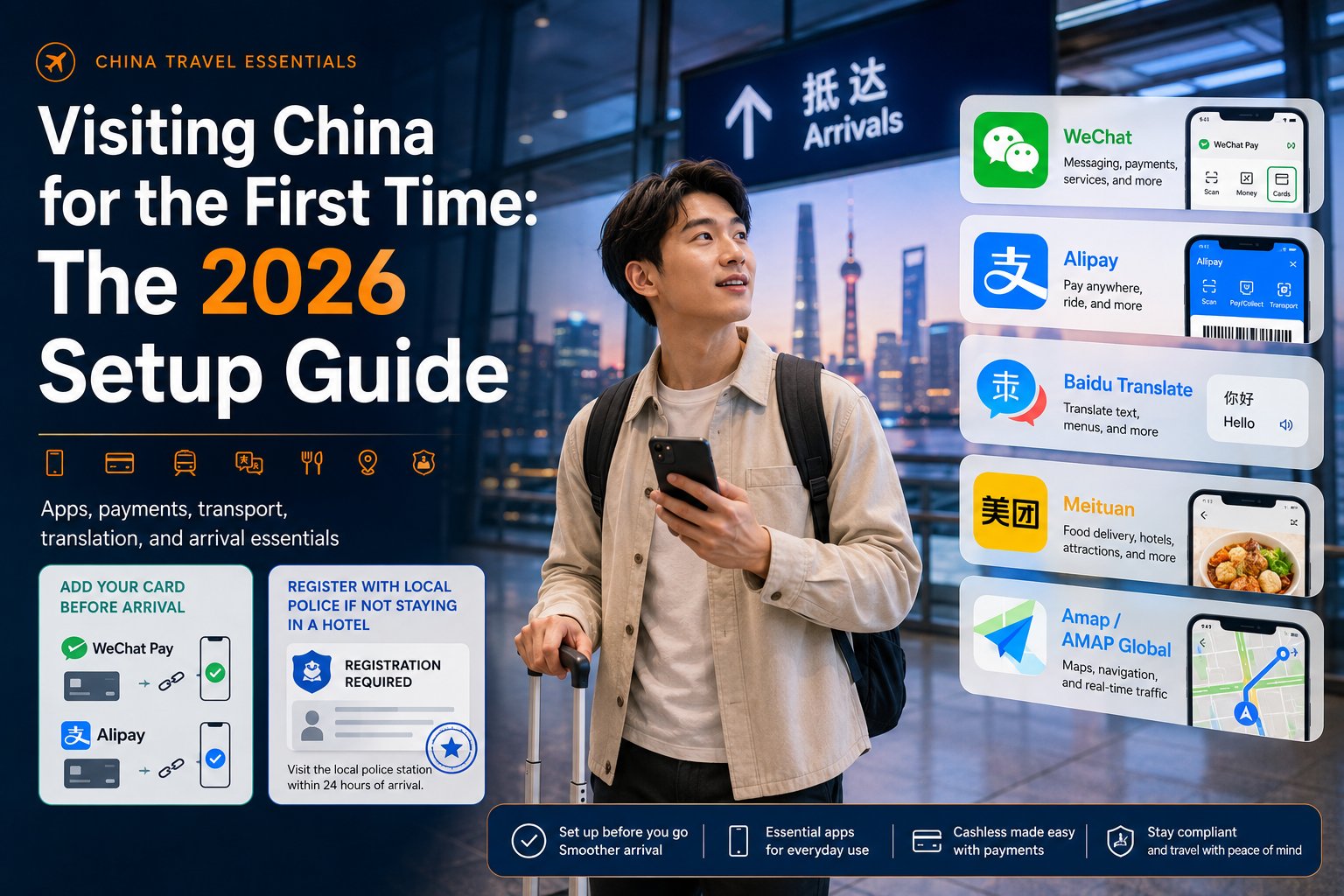
Every Canton Fair season I end up doing the same thing in the arrivals hall at Guangzhou Baiyun. A client lands, shakes my hand, and then says the sentence I have heard a hundred times: "my card doesn't work anywhere." They have flown eleven hours to meet factories and they cannot buy a bottle of water.
None of this is hard. It is just unfamiliar, and almost all of it is easier to do at home on your own wifi than standing jet-lagged next to a luggage carousel. So this is the full setup, in the order you need it: what to do before the flight, what happens in your first 24 hours, and how to move, pay, eat and do business once you are here.
If you would rather not read 3,000 words, don't. Every section below has a graphic that carries the whole point on its own. Scroll, look at the pictures, and you will still land prepared.
What do I need to do before I fly to China?
Four things, and three of them happen before you leave home. Install and verify Alipay, WeChat and Amap with a working card, confirm your visa route, sort out data, and know who registers your address in the first 24 hours. China is now the easiest it has ever been for foreign visitors, and the numbers show it: in 2025, 30.08 million foreign nationals entered China visa-free, up 49.5 percent year on year (China's National Bureau of Statistics via gov.cn, February 2026).
Which apps do I actually need on my phone?
Four, and two of them do most of the work. Alipay and WeChat carry payments, metro tickets, taxis and food delivery, because everything else runs inside them as mini programs. China's digital habits explain why: 1.022 billion people, or 91 percent of the country's internet users, were using online payments by mid-2025 (CNNIC statistical report, via China Internet Watch, 2025).
The third is Amap, and it is the one most first-timers have never heard of. Google Maps is not usable here, so Amap is how you find anything, and it now runs in English.
The fourth is Baidu Translate (百度翻译), and there is a specific reason to name it rather than say "a translation app". Google shut Google Translate down in mainland China in 2022, so the app most visitors reach for first simply does not work here (Associated Press via The Hill, October 2022). Baidu Translate covers more than 200 languages, has an English interface, translates from the camera, and works offline once you download the Chinese pack (China Daily government service portal, 2025).
Download that offline pack before you fly. The camera mode is the feature you will actually live on, and it keeps working in a basement restaurant with no signal.
You do not need to download DiDi, Meituan or a metro app separately. Search for them inside Alipay or WeChat instead. Fewer accounts, fewer verification screens, and the payment is already attached.
One thing worth being careful about: match the icon and the Chinese characters against the store listing before you tap install. Apps with near-identical English names show up in search results, and a first-time visitor has no easy way to tell them apart.
One warning that catches nearly everyone. WeChat ships in two versions: the international app, and the mainland one, which is listed in Chinese app stores under its Chinese name Weixin (微信). Payment features behave differently between them. If your wallet section looks empty when you arrive, that is usually why, and switching your region setting inside the app normally fixes it.
How do I pay for things in China with a foreign card?
You link your Visa, Mastercard or other international card inside Alipay or WeChat Pay, then pay by QR code like everyone else. Beijing municipal government guidance is explicit on the cost: "Transaction fees are waived for single transactions under 200 RMB. A 3% transaction fee will be applied for single transactions above 200 RMB" (Chaoyang District People's Government, Beijing, 2026).
That 200 RMB line matters more than it sounds. Breakfast, a metro ride, a taxi across town, a bag of fruit, lunch for two: almost all of it sits under 200 RMB, so almost all of it costs you nothing extra. The fee only shows up on hotel bills, big dinners and shopping.
Linking the card takes about ten minutes. The order matters, because the verification step is the one that occasionally stalls, and you want that happening in your own living room.
Keep some cash too, maybe 300 to 500 RMB. Not because you will need it often, but because a dead phone battery in a country where the phone is the wallet is a genuinely awkward situation. A power bank is worth more here than in most countries.
Do I need a visa to visit China in 2026?
Possibly not. As of February 2026, 50 countries hold 30-day unilateral visa-free entry, extended through 31 December 2026, with Canada and the UK added on 17 February 2026 (China Briefing, China Visa-Free Travel Guide, 2026). A separate 240-hour transit route covers 55 nationalities at 65 ports.
The distinction is worth understanding, because they are not the same thing. Visa-free entry lets you come and go as you like for 30 days. The 240-hour transit route requires a confirmed onward ticket to a third country, which means you cannot simply fly back the way you came.
The direction of travel is clear. In the first quarter of 2026 alone, foreign nationals made roughly 8.32 million visa-free entries, close to 78 percent of all inbound foreign crossings and up almost 30 percent year on year (gov.cn statistics release, April 2026). Whatever you heard about Chinese visas five years ago is probably out of date.
Do I have to register with the police when I arrive?
Yes, and this is the rule foreign visitors most often break without realising. Under the Exit and Entry Administration Law, your address must be registered within 24 hours of arrival in urban areas, and failure to do so can bring a warning or a fine of up to 2,000 RMB (China Briefing, Temporary Residence Registration guide, 2026).
If you are in a hotel, relax. That passport scan at check-in is the registration, and the hotel files it electronically. The problem only appears when someone books an apartment or stays with a friend, which is exactly what a lot of repeat business visitors start doing on their second or third trip.
How do I get around: metro, buses, taxis and trains?
By phone, mostly. Open Alipay, tap Transport, pick your city, and it generates a QR code the metro gates and bus readers accept in more than 100 Chinese cities. No ticket machine, no exact change, no card to top up. For everything else there is DiDi, which runs as a mini program inside both Alipay and WeChat, or Amap, which books the same cars from inside the map.
Honestly, the metro is usually better than a taxi anyway. Signage is bilingual in every major city, stations announce stops in English, and it beats sitting in Guangzhou traffic at six in the evening.
Amap is the map, and it books taxis too
Google Maps is not usable on a mainland connection, which strands a lot of first-time visitors. Amap (高德地图) is what everyone here actually uses, and since July 2025 it runs in English and thirteen other languages. Hainan's provincial government guide confirms it gives foreign users "various travel routes based on different modes of transportation, including driving, public transit, walking and biking", plus the ability to "book a taxi straight to your final stop" (People's Government of Hainan Province, AMap English guide, 2025).
That taxi button is the part people miss. You do not have to leave the map, open DiDi and retype the destination. You tap the ride tab, and Amap sends the request out to DiDi and several smaller platforms at once, which is often cheaper than booking DiDi directly.
Search for AMap Global in your app store. It is a separate listing from the mainland-only version, and it is the one that opens in English.
High-speed rail is genuinely better than flying
Guangzhou to Shenzhen is about half an hour. Shanghai to Beijing is a morning. Book on the official 12306 English platform, which is open to holders of foreign passports recognised by the PRC government, and where "tickets can be bought from 12306 15 days in advance till 30 minutes before train departure" (MTR High Speed Rail, 12306 ticketing guidance, 2026).
There is no paper ticket to collect. You register with an email address, pay by international card or UnionPay, and your passport becomes the ticket. At the station you use the staffed lane rather than the ID-card gates, an attendant scans the passport, and that is it. Arrive 30 minutes early, because security screening at big stations takes a while.
Will my phone and internet work in China?
Your phone will work. Some of your usual apps will not, at least not on a local connection. A number of widely used western services are unreachable from a mainland Chinese network, which is why most business visitors keep international roaming or a travel eSIM running instead of relying on hotel wifi alone.
One rule to remember about local SIM cards: real-name registration is mandatory, and your original passport is the only accepted document. Photocopies get refused. That means you cannot buy and activate a Chinese SIM before you arrive.
How do I order food when the menu is only in Chinese?
Point the camera at it. Almost every restaurant in urban China now puts a QR code on the table which opens the menu with photos, and Baidu Translate's camera mode handles the rest. Delivery works the same way through Meituan or Ele.me, both of which sit as mini programs inside Alipay and WeChat, with most orders arriving within about 30 minutes.
The one thing to prepare in advance: get your hotel's address written in Chinese characters and save it in your notes. Ask reception, or copy it from the booking confirmation. You will paste it into delivery apps, show it to taxi drivers, and use it more than any other piece of text on your phone.
And no, you do not tip. Not in restaurants, not in taxis, not for delivery. Leaving money on the table will usually produce someone chasing you down the street to give it back.
What should I know before a business meeting in China?
The mechanics matter more than the theory. Business cards get passed and received with both hands, then placed on the table in front of you in seating order rather than shoved in a pocket. Seating at a banquet follows status, with the host and senior guests positioned by rank, and toasts follow that same hierarchy.
What I tell clients before their first factory dinner: you are not being tested on chopstick technique. You are being watched for whether you respect the order of things. Hold your glass slightly lower than a senior person's when you clink, and you have said more than any speech would.
If your trip includes factory visits, the etiquette is only half of it. What you do on the factory floor matters more, and I wrote that up separately in how to verify a Chinese factory before you wire a deposit. If the Canton Fair is what brings you here, the Canton Fair importer's guide covers badges, halls and how to work the booths.
What actually catches first-time visitors out
After several years of meeting clients off flights into Guangzhou, the same handful of problems come up again and again. None of them are about China being difficult. They are about small assumptions that quietly do not hold here.
The battery one is the big one. When your phone is your wallet, your ticket, your map and your translator, a flat battery is not an inconvenience, it is being stranded. Every experienced China traveller I know carries a power bank and a charging cable in their day bag, not in the suitcase back at the hotel.
The second is verification codes. Plenty of services want to text a code to a number, and if you have swapped to a Chinese SIM your home number may not be reachable. Keep your home SIM in the phone if it is dual-SIM, or keep roaming active for the first day at minimum.
The third is timing. Factory tours, banks, and government offices all take a proper lunch break, usually somewhere between noon and 2pm. Nothing happens in that window. Plan the meeting either side of it, and use the gap to eat properly rather than fighting it.
Frequently asked questions
Can I use my Visa or Mastercard in China in 2026?
Not directly in most shops, but you can link the card inside Alipay or WeChat Pay and pay by QR code everywhere. Official Beijing government guidance confirms transaction fees are waived on single payments under 200 RMB, with a 3 percent fee above that. Carry the physical card anyway for hotels and airports.
Do I need a visa to visit China in 2026?
It depends on your passport. Fifty countries currently get 30-day unilateral visa-free entry, extended through 31 December 2026, and 55 nationalities can use the 240-hour visa-free transit route if they hold an onward ticket to a third country. Everyone else needs a visa from a Chinese embassy or consulate.
Do I have to register with the police when I arrive in China?
Yes. Under the Exit and Entry Administration Law you must be registered at your address within 24 hours in urban areas. Hotels do this automatically when they scan your passport at check-in. If you stay in an apartment or with friends you must register yourself at the local police station, or face a fine of up to 2,000 RMB.
How do I book high-speed train tickets in China as a foreigner?
Use the official 12306 English app or website, which accepts registration by email and payment by international card or UnionPay. Tickets go on sale 15 days before departure and there is no paper ticket. Your passport is scanned at the gate and acts as the ticket itself.
Which apps should I install before flying to China?
Four: Alipay and WeChat for payments, Amap for maps and taxis, and Baidu Translate for camera translation. Alipay and WeChat matter most because metro QR codes, DiDi and food delivery all run inside them as mini programs. Add the 12306 English app if you plan to take trains. Install and verify everything at home.
Does Google Maps work in China, and what should I use instead?
Google Maps is not usable on a mainland connection. Use Amap, listed in app stores as AMap Global, which has run in English since July 2025 and covers driving, public transit, walking and cycling routes. It also books a taxi to your destination from inside the map, without switching to DiDi.
Will my normal apps and email work in China?
Many popular western services are not reachable on a local Chinese connection. International roaming from your home carrier and most travel eSIMs route your traffic outside the mainland, which is why most business visitors keep roaming or an eSIM active rather than relying only on hotel wifi.
Key takeaways
- Install Alipay, WeChat, Amap and Baidu Translate, link a card and verify your passport at home. DiDi, Meituan and metro tickets all live inside them as mini programs.
- Foreign card payments under 200 RMB carry no service fee, and 3 percent above it. That covers almost all daily spending.
- Check your visa route before booking. 50 countries have 30-day visa-free entry through 31 December 2026, and 55 qualify for 240-hour transit.
- Your address must be registered within 24 hours. Hotels handle it. Apartments and friends' homes are on you, with a fine of up to 2,000 RMB.
- Carry a power bank. Your phone is your wallet, ticket, map and translator, and a flat battery leaves you with none of them.
Sources
- China's National Bureau of Statistics via gov.cn, "Foreigners entering China visa-free up 49.5 pct in 2025", retrieved 2026-07-30, english.www.gov.cn
- gov.cn statistics release, "China sees solid rise in cross-border travel in Q1", retrieved 2026-07-30, english.www.gov.cn
- Chaoyang District People's Government, Beijing, "Overseas Bank Cards Accepted by Weixin Pay and Alipay", retrieved 2026-07-30, english.bjchy.gov.cn
- Beijing Municipal Government, "WeChat Pay Exempts 3% Transaction Fees for International Card Purchases Under CNY 200", retrieved 2026-07-30, english.beijing.gov.cn
- China Briefing, "China Visa-Free Travel: A Complete Guide", retrieved 2026-07-30, china-briefing.com
- China Briefing, "Temporary Residence Registration in China: A Guide for Foreigners", retrieved 2026-07-30, china-briefing.com
- Embassy of the People's Republic of China, "List of Countries Eligible for China's 240-Hour Visa-Free Transit Policy", retrieved 2026-07-30, china-embassy.gov.cn
- MTR High Speed Rail, "Purchase ticket on 12306 China Railway", retrieved 2026-07-30, highspeed.mtr.com.hk
- People's Government of Hainan Province, "A guide to using AMap in English", retrieved 2026-07-30, en.hainan.gov.cn
- China Daily government service portal, "What is a good free and easy-to-use translation app for China?", retrieved 2026-07-30, govt.chinadaily.com.cn
- Associated Press via The Hill, "Google discontinues Google Translate in mainland China", retrieved 2026-07-30, thehill.com
- CNNIC statistical report via China Internet Watch, "China Internet Overview 2025", retrieved 2026-07-30, ciw.news
Visa lists, payment limits and registration procedures change. Confirm your own situation with the National Immigration Administration and your embassy before booking.
Coming to China to meet factories?
I am based in Guangzhou and I do this every Canton Fair season: airport pickup, apps set up on day one, translation in the meeting room, and factory visits that are actually worth the flight. Tell me your dates and what you are sourcing.
Plan your China trip