China’s Specialist Wholesale Markets: The Towns That Beat Yiwu at One Thing
 Hidayat Khan·Sep 2026·11 min read
A client was buying pendant lamps out of Yiwu. Decent price, decent quality, no complaints. Then he asked me to check whether he could do better, and the answer was embarrassing: the Yiwu seller was buying them in Guzhen, adding a margin, and selling them back to him.
Guzhen is a town in Zhongshan, about two hours from Guangzhou, and it does almost nothing except lighting. Around 45,000 lighting and related businesses in one place. Nobody had told him it existed, because the general markets have no reason to.
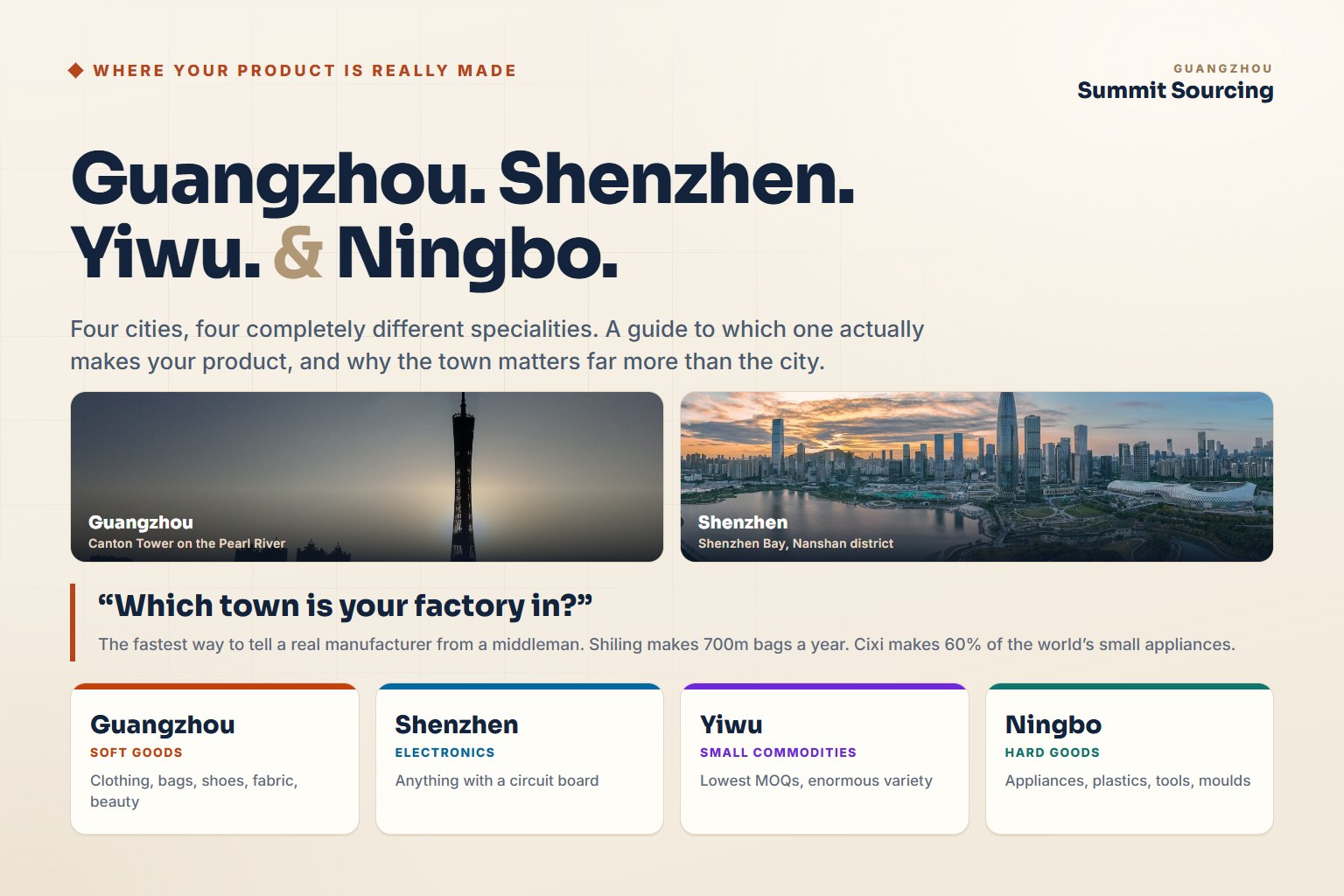
I wrote before that the town matters more than the city. This is the answer key: the specialist markets that beat the famous ones, if your product happens to match. Every section has a graphic if you would rather skim.
Which specialist market matches your product?
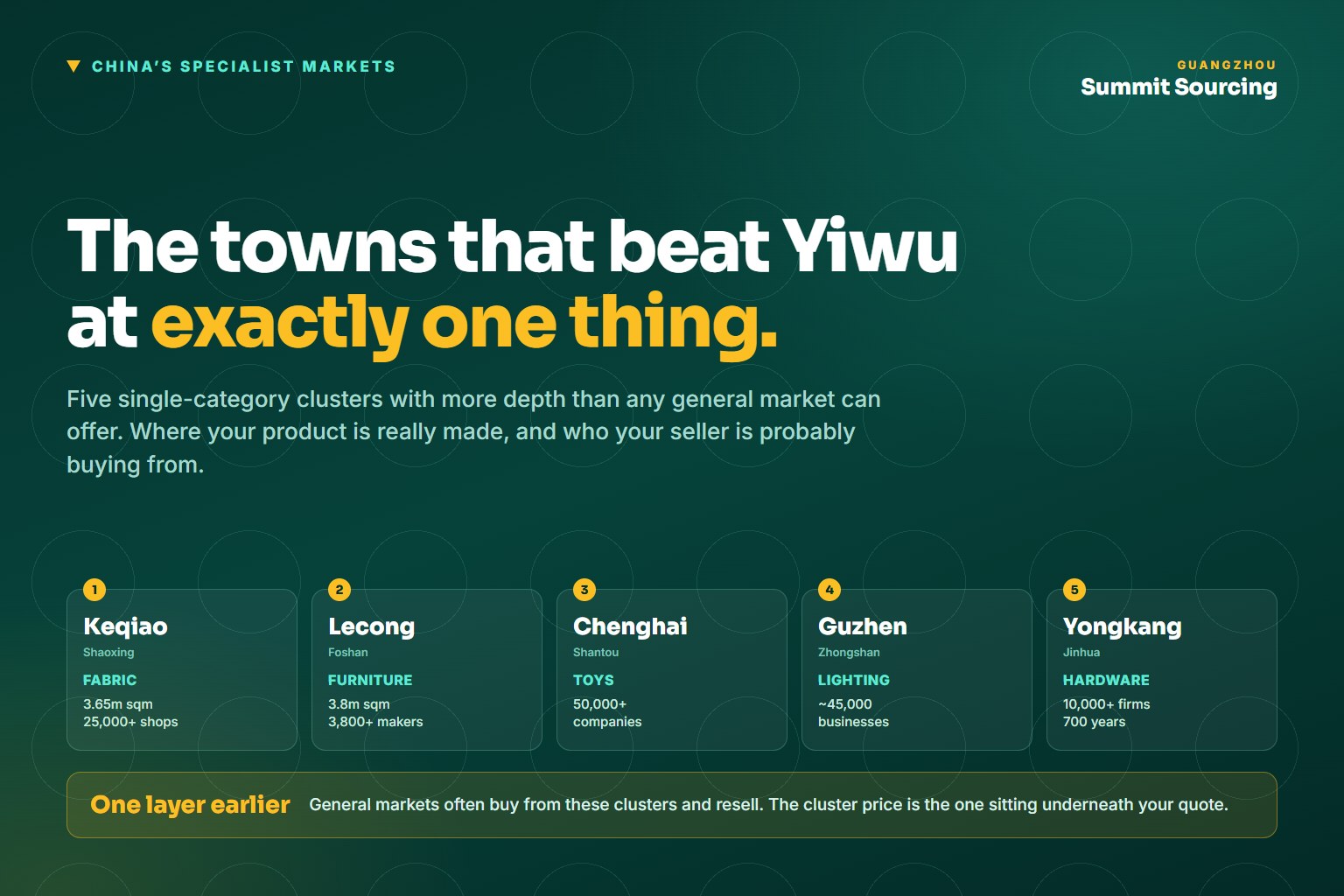
Fabric goes to Keqiao, furniture to Lecong, toys to Chenghai, lighting to Guzhen, hardware and tools to Yongkang. Each is a single-category cluster with more depth than any general market can offer. Keqiao's China Textile City alone spans over 3.65 million square metres with more than 25,000 shops, drawing buyers from over 190 countries.
The trade-off is simple. A specialist cluster is unbeatable for its one category and useless for everything else. Yiwu will sell you forty product types under one roof. Guzhen will sell you lighting, and only lighting, better than anywhere on earth.
How big is Keqiao, really?
Big enough that most buyers underestimate it by an order of magnitude. China Textile City in Keqiao, Shaoxing, runs to more than 3.65 million square metres with over 25,000 shops and something in the region of 30,000 suppliers, pulling roughly 100,000 visitors a day and reported daily turnover around 180 million RMB.
To put that in perspective, Guangzhou's Zhongda fabric market, which I have called enormous in print, is about 5 square kilometres with 23,000 shops. Keqiao is a comparable scale of business concentrated in a single market complex rather than spread across a district, and it sits in the middle of the Zhejiang weaving belt rather than an hour from it.
If you buy fabric in any volume, this is the trip that pays for itself. If you buy finished garments, it usually is not, because you want the garment factory, not the mill that supplies it.
What makes Lecong different from a furniture market?
The factories are behind the showrooms. Lecong in Shunde, Foshan, runs about 3.8 million square metres of furniture showrooms along a strip roughly five kilometres long, backed by more than 3,800 manufacturers, and locals describe the model as "front store, back factory" with a raw material sourcing radius of under ten kilometres.
That last detail is the one that matters. In most furniture sourcing you are talking to a showroom that orders from a factory that orders materials from somewhere else entirely. In Shunde the whole chain sits inside a short drive, which is why lead times there are often shorter than a quote from a bigger, more famous city suggests.
Toys, lighting and hardware: the three one-product towns
These are the clearest examples of what a Chinese cluster actually is. Chenghai in Shantou has upwards of 50,000 toy-related companies. Guzhen in Zhongshan holds around 45,000 lighting businesses and is credited with roughly 70 percent of China's domestic lighting market. Yongkang has over 10,000 hardware firms and has been making hardware for about 700 years.
A word of caution on those percentages. You will see Chenghai credited with anywhere between a third and 70 percent of the world's plastic toys depending on which source you read, and the same spread applies to most cluster claims. They come from local government and industry bodies rather than audited data. The direction is reliable, the decimal places are not.
Specialist cluster or general market?
It comes down to how many categories you buy and how much of each. A general market like Yiwu wins on breadth and low minimums; a specialist cluster wins on price, depth of range and technical understanding within its category. Neither is better in the abstract.
When is the detour actually worth it?
Roughly when one category is more than half your order value, or when you are ordering the same thing repeatedly. A trip to Guzhen or Keqiao costs you a day or two and a domestic flight. That only pays back if the volume behind it is real.
The other trigger is technical difficulty. If your product needs a mould, a specific fabric weight, a particular driver or dimmer behaviour, a general-market trader will nod at everything and get half of it wrong. In the cluster you are talking to someone who makes it.
What I do with this in practice
Before I quote anything, I check whether the product has a cluster. If it does, I price it there as well as wherever the client found it. The gap between those two numbers tells me how many hands the product has already passed through.
The lamp client from the opening is the clean example. We priced the same pendant in Guzhen, found the Yiwu seller was adding a comfortable margin on top of a Guzhen price, and moved the order. He did not fly anywhere. What changed was simply knowing the town existed and that the seller had not mentioned it.
The honest limit: he now buys a full pallet of lighting at a time instead of mixing lamps into a container with four other product types. That suits him. If he were still testing three lamp designs at fifty units each, Yiwu would have stayed the right answer.
A quick way to check
Search your product category plus "China industrial cluster" or the Chinese term for the product plus 之都, which means "capital of". If a town comes up repeatedly, that is where your product is really made, and it is worth pricing there before you accept a quote from anywhere else.
Frequently asked questions
What is the largest fabric market in China?
China Textile City in Keqiao, Shaoxing. It runs to more than 3.65 million square metres with over 25,000 shops and around 30,000 suppliers, drawing roughly 100,000 visitors a day from more than 190 countries. Guangzhou's Zhongda market is the main southern alternative.
Where are toys made in China?
Overwhelmingly in Chenghai, a district of Shantou in Guangdong, which has upwards of 50,000 toy-related companies and a complete local chain covering design, moulds, production, packaging and export. Published estimates of its share of world plastic toy output vary widely between sources.
Is Guzhen really the lighting capital?
By concentration, yes. Guzhen in Zhongshan holds around 45,000 lighting and related businesses and is commonly credited with roughly 70 percent of China's domestic lighting market. Those share figures come from local industry bodies rather than audited statistics, so treat them as indicative.
Is a specialist cluster always cheaper than Yiwu?
For its own category, usually, because Yiwu sellers frequently buy from the cluster and resell. But clusters carry higher minimums and do not help with mixed loads. If you buy several categories in small quantities, Yiwu often still wins on total cost.
Do I have to visit the cluster myself?
No. Most of the benefit comes from pricing the product at the cluster and dealing with a maker rather than a reseller, which can be done remotely. Visiting matters most for technically fussy products, first production runs, or when you need to check a factory in person.
How do I find the cluster for my product?
Search the category name with "China industrial cluster", or the Chinese product name with 之都, meaning "capital of". Chinese towns advertise these titles heavily. If the same town keeps appearing across sources, that is where your product is actually made.
Key takeaways
- Fabric goes to Keqiao, furniture to Lecong, toys to Chenghai, lighting to Guzhen, hardware to Yongkang. Each beats the general markets within its own category.
- General markets often buy from these clusters and resell. If your seller is in Yiwu, the cluster price is the one underneath theirs.
- Clusters mean higher minimums and no mixed loads. Several categories in small amounts still favours a general market.
- Technically fussy products belong in the cluster, where the seller actually makes the thing rather than reselling it.
- Cluster share percentages come from local government and industry bodies, not audits. The direction is right; the precise numbers are not.
Sources
- Keqiao China Textile City market scale (floor area, shop and supplier counts, daily visitors and turnover), compiled from published market guides, retrieved 2026-08-31, jingsourcing.com
- Lecong and Shunde furniture cluster scale and the "front store, back factory" model, retrieved 2026-08-31, chinaguide.in
- Chenghai toy cluster company counts and industry structure, Guangdong provincial media, retrieved 2026-08-31, newsgd.com
- Guzhen lighting cluster enterprise count and domestic market share, Guangdong provincial media, retrieved 2026-08-31, goguangdong.southcn.com
- Yongkang hardware cluster enterprise count and history, retrieved 2026-08-31, chinaguide.in
- Cluster market-share percentages in this article originate with local government and industry bodies and are not independently audited. Published figures for the same cluster differ substantially between sources, so they are used here to show relative dominance rather than precise share.
Want to know if your product has a cluster?
Send us the product. We will tell you which town makes it, what it costs at source, and whether your current supplier is buying it there and reselling to you.
Get a free quote