Alibaba vs 1688 vs Made-in-China vs Global Sources: Which Should You Use?
 Hidayat Khan·Aug 2026·11 min read
A client messaged me last year with a screenshot and one line: "I think my supplier has been robbing me." He'd found his own product on 1688 at 18.5 RMB. He was paying 4.20 dollars for it on Alibaba. Same photo, same model number, same factory town.
He hadn't been robbed. He'd just discovered that these platforms aren't four competitors selling the same thing. They're four different layers of the same supply chain, and the price gap between them is mostly the cost of somebody handling export, English, paperwork and risk. Sometimes that somebody should be you. Usually it shouldn't.
So here's the honest comparison, from someone who buys on all four of these every month. If you'd rather not read 2,500 words, don't. Every section has a graphic that carries the point on its own.
Which platform should you actually use?
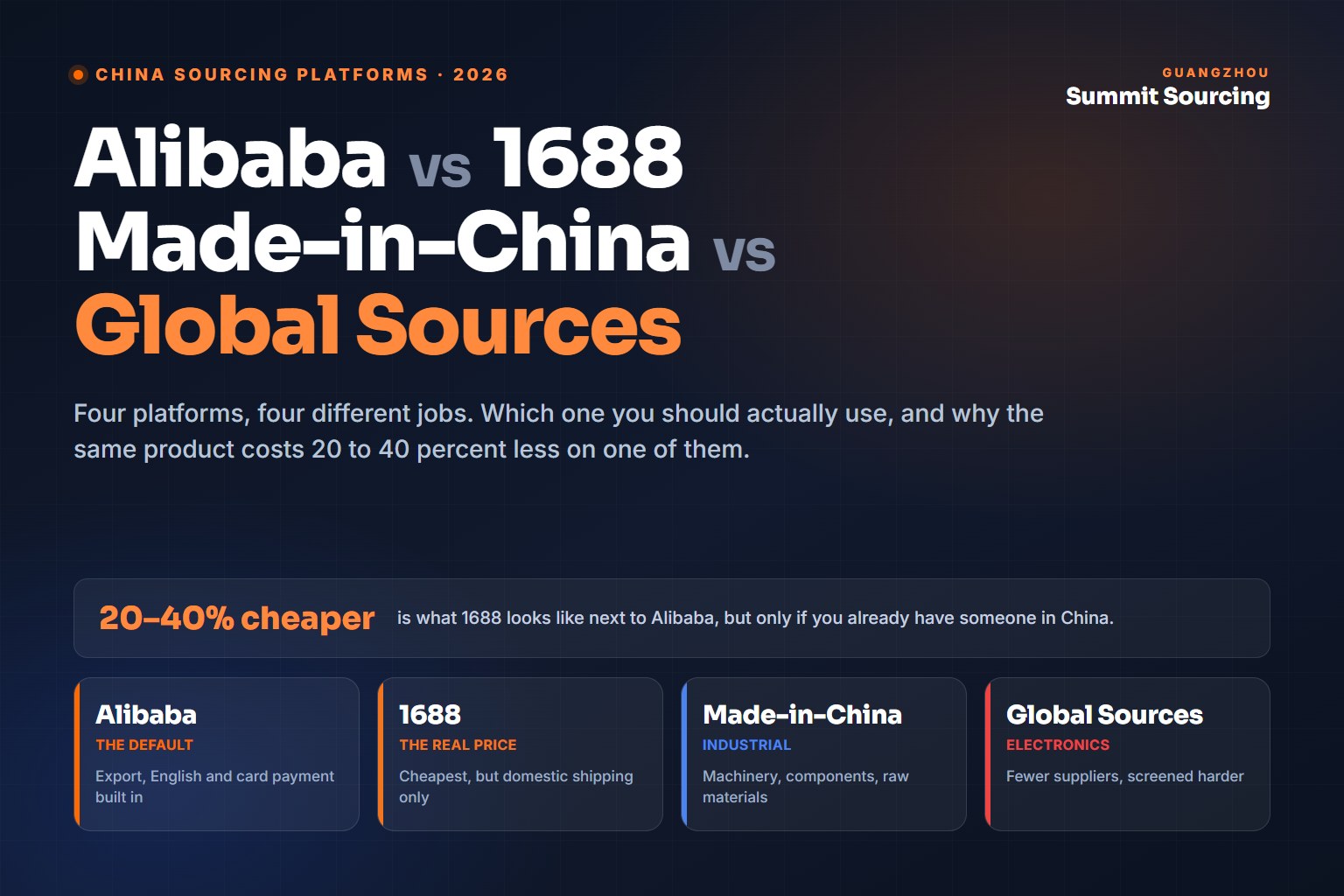
Alibaba.com for most first orders, 1688 once you have someone in China, Made-in-China.com for industrial and machinery, Global Sources for electronics. Alibaba wins on default because it's the only one of the four built end to end for a foreign buyer paying with a foreign card, and its Trade Assurance programme is free to buyers (Alibaba.com Trade Assurance, 2026).
That's the whole answer. Everything below is why, and where it breaks.
What is each platform, in one line?
Alibaba.com is China's export shop window. 1688 is the domestic wholesale market that sits behind it, owned by the same company. Made-in-China.com is the industrial specialist with roughly 400,000 registered suppliers. Global Sources is the oldest of the four, Hong Kong based, with 55 years of trade history and a deliberately smaller, harder-screened supplier list (Global Sources, 2026).
The thing nobody tells you: Alibaba and 1688 are the same company. Both are Alibaba Group. Your Alibaba or Taobao login usually works on 1688 already, because they share an account system. The price difference between them isn't two rival marketplaces competing. It's one company selling to two different audiences.
Why is 1688 so much cheaper?
Because the 1688 price is a domestic price, and it assumes you'll do the export work yourself. Published comparisons put the gap between roughly 15 and 50 percent for identical specs, with most landing in the 20 to 40 percent band (WorldFirst, 2026). The range is wide because the gap depends entirely on the category.
Here's what that gap is actually paying for on Alibaba: export documentation, an English-speaking sales team, escrow, international payment handling, and the cost of carrying risk on a stranger buying from ten thousand miles away. None of that is free. On 1688 the seller assumes a Chinese buyer who arranges all of it themselves.
So the 1688 price isn't the real price of your product. It's the real price of your product if you already have a warehouse, a payment method and an inspector in China. If you don't, the gap gets eaten by the cost of assembling one.
How much protection do you actually get?
Less than most buyers assume. Alibaba's Trade Assurance covers two specific things: shipping on time, and the goods matching the spec written into the order. Claims run within 30 days of delivery, and it only applies to orders placed and paid through Alibaba's own platform (Alibaba.com Trade Assurance, 2026).
Read that last part twice. The single most common way people lose Trade Assurance is being talked into paying by direct bank transfer because "it's faster" or "we can give you a better price". The moment the money leaves the platform, the protection is gone. Every time.
And here's the distinction that costs people the most money: Trade Assurance is payment protection, not supplier verification. It doesn't mean anyone visited the factory. It means Alibaba will mediate if the order goes wrong. Those are very different promises, and a lot of first-time buyers treat the badge as a green light to skip due diligence entirely.
The other three handle this differently. Made-in-China.com and Global Sources both run verified or audited supplier badges, and Global Sources in particular built its whole reputation on screening fewer suppliers more carefully. But no badge on any platform replaces checking the supplier yourself, which is why verifying the factory before you wire a deposit matters regardless of where you found them.
Which platform wins for your product category?
Category is the second-biggest factor after whether you have someone in China. Global Sources concentrates on consumer electronics, and its April 2026 Hong Kong shows ran over 4,000 booths with more than 2,000 suppliers and around 150,000 products, drawing a projected 60,000-plus buyers (Global Sources via PR Newswire, April 2026). Made-in-China.com skews industrial.
How do you spot a trading company on any of them?
The same three checks work on all four platforms, because none of them reliably distinguishes a factory from a middleman in the listing itself. Alibaba has the widest supplier base of the four, which also means the widest quality spread, and trading companies presenting as manufacturers are common across every export platform.
This is the part I'd keep if you forget everything else in this article. A trading company isn't automatically bad. Plenty are useful, especially for small orders or mixed containers. The problem is only ever paying factory-direct prices for a middleman's service, or being told you're dealing with the factory when you aren't.
What I actually do for clients
I use two platforms for every product, always. Alibaba or Made-in-China to find the supplier and read their export history, then 1688 to sanity-check what the domestic price looks like. The gap between those two numbers tells me more about a quote than any amount of negotiating does.
If a supplier quotes me 4.20 dollars and the same item sits at 18.5 RMB on 1688, that's roughly a 60 percent spread. Sometimes it's justified, because export packaging, certification and testing are real costs. Sometimes it means I'm talking to the fourth person in a chain. Either way I now know which conversation to have.
That client from the opening? We didn't move him to 1688. He didn't have anyone in China, so 1688 would have meant paying an agent anyway. We kept the Alibaba supplier, showed them the domestic pricing, and renegotiated. He landed at 3.35 dollars with the same factory and no new risk. Sometimes the point of knowing the 1688 price is just knowing it.
The one habit worth stealing
Before you accept any quote, spend ten minutes finding the same product on 1688. You don't have to buy there. You just need to know what the number looks like without the export layer on top. It changes how you negotiate, and it costs nothing.
Frequently asked questions
Is 1688 cheaper than Alibaba, and by how much?
Yes, usually. Published 2026 comparisons put the gap between roughly 15 and 50 percent for the same specification, with most cases landing in the 20 to 40 percent band. The difference is the export layer: documentation, English support, escrow and payment handling that 1688 sellers assume you'll arrange yourself.
Can I buy from 1688 without speaking Chinese?
You can browse it with browser translation, but you can't complete a normal order alone. 1688 sellers ship domestically and expect Chinese payment methods, so overseas buyers need someone in China to pay the seller, receive the goods and forward them. That's the real cost of the lower price.
Does Alibaba Trade Assurance mean the supplier is verified?
No. Trade Assurance is payment protection, not supplier verification. It covers on-time shipping and goods matching your written order spec, with claims inside 30 days of delivery, and only on orders paid through Alibaba. Nobody has necessarily visited the factory.
Which platform has the most real factories rather than trading companies?
1688 has the highest concentration of actual factories and domestic wholesalers, because it isn't built for export. Global Sources screens hardest among the export platforms. But every platform carries trading companies, so check the product range, business licence and a live video walk regardless.
Should I use Made-in-China or Global Sources instead of Alibaba?
Use them alongside it, not instead of it. Made-in-China.com is stronger for machinery, components and raw materials, with around 400,000 registered suppliers. Global Sources is stronger for consumer electronics. Both are useful cross-checks when an Alibaba quote looks odd.
Can the same factory be on more than one platform?
Very often, yes, and at different prices. The same manufacturer may list on Alibaba, Made-in-China and 1688 simultaneously with different pricing on each, because each listing targets a different buyer. Searching two platforms for one product is the cheapest research you can do.
Key takeaways
- Alibaba.com is the right default for a first order, because it's the only one of the four built end to end for a foreign buyer paying with a foreign card.
- 1688 runs 20 to 40 percent cheaper, but sellers ship only inside China and take Chinese payment. That price is real only if you have someone here.
- Trade Assurance is payment protection, not supplier verification, and it dies the moment you pay outside the platform.
- Category matters: Global Sources for electronics, Made-in-China for machinery and components, 1688 for clothing, packaging and low-quantity tests.
- Price every product on two platforms before you accept a quote. Ten minutes of checking beats an hour of negotiating.
Sources
- Alibaba.com, "Trade Assurance protects your Alibaba.com orders", retrieved 2026-08-27, buyer.alibaba.com
- Global Sources via PR Newswire, "The April 2026 Global Sources Hong Kong Show Phase I Opens Today", retrieved 2026-08-27, prnewswire.com
- Global Sources, company profile and Verified Supplier programme, retrieved 2026-08-27, globalsources.com
- WorldFirst, "1688 vs Alibaba: Which is better?", retrieved 2026-08-27, worldfirst.com
- Supplier counts for Alibaba.com and Made-in-China.com are self-reported by the platforms and are not independently audited. They are used here as scale indicators only.
Not sure which platform fits your product?
We source on all four every week, from our office in Guangzhou. Send us the product and we'll tell you where it's actually made, what it should cost, and whether you need us at all.
Get a free quote