The $800 De Minimis Exemption Is Gone: What It Actually Costs You Now
 Hidayat Khan·Aug 2026·10 min read
A client called me in July, genuinely confused. He sells a $19 kitchen gadget, ships it in small batches by air, and his customs bill had gone from nothing to more than his freight. He wanted to know which supplier had messed up.
None of them had. The rule that let his shipments in duty-free had been switched off, permanently, and nobody had told him. He was still shipping the way he had shipped for four years, into a system that no longer works that way.
This is the biggest change to small-scale importing in a decade, and most sellers I speak to still have not adjusted for it. Here is what actually happened, what it costs, and how to restructure. Every section has a graphic if you would rather skim.
What exactly changed, and when?
The $800 de minimis exemption is gone. On 24 June 2026, US Customs and Border Protection made the suspension indefinite by regulation for everything arriving by ocean, air, truck, rail or express courier, meaning goods worth $800 or less must now use formal or informal entry procedures like any other import (CBP, Federal Register, RIN 1685-AA44, June 2026).
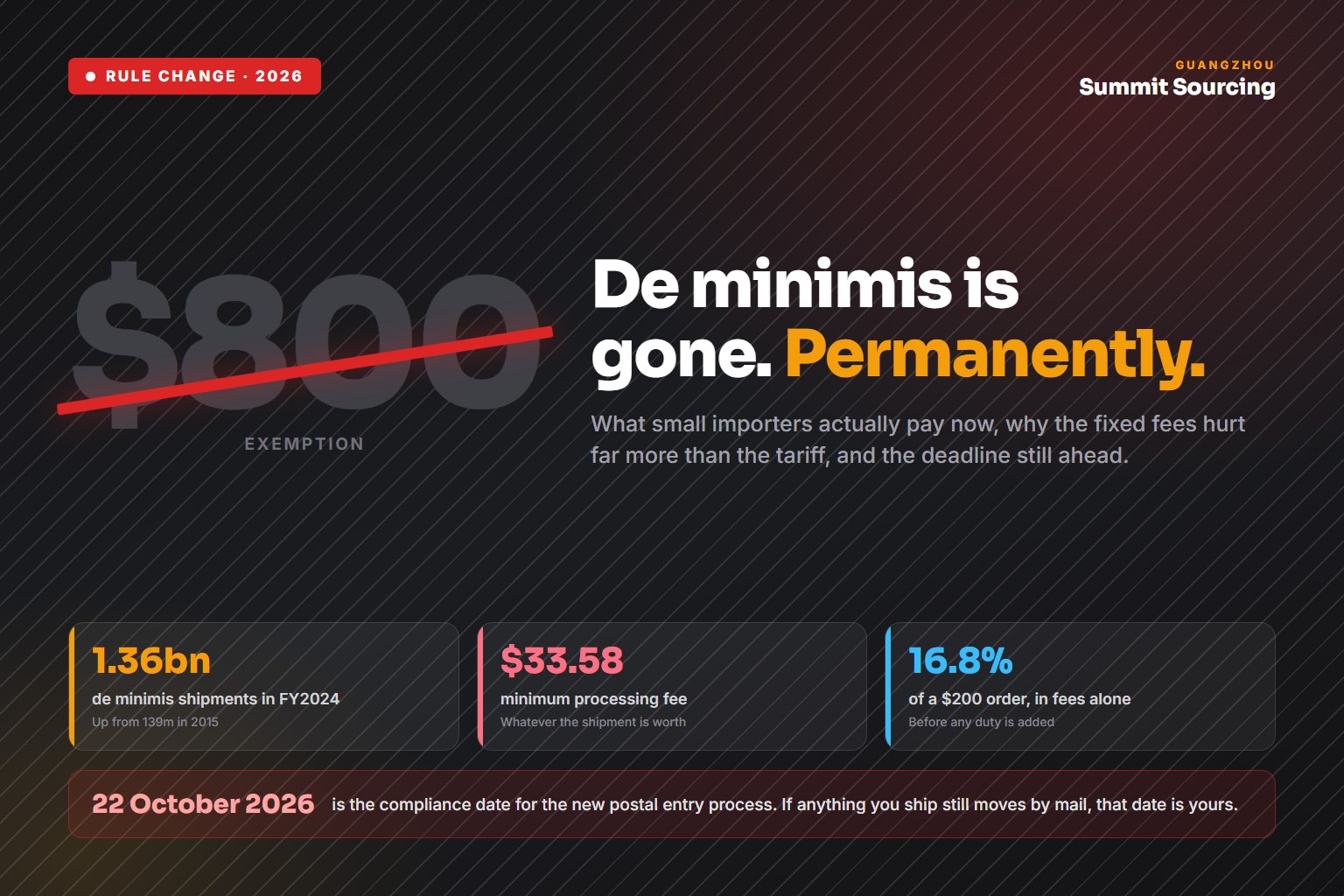
A companion rule covers international mail. It took effect on 24 July 2026, with a compliance date of 22 October 2026. That one is still ahead of us, and it is the deadline worth putting in your calendar.
One thing worth saying plainly: this is a US rule. If you import into the UK, the EU or Australia, your own low-value thresholds are moving too, but on different timetables. Everything below is about bringing goods into the United States.
How big was de minimis, really?
Enormous, and that is why it went. CBP processed over 1.36 billion de minimis shipments in Fiscal Year 2024, which the agency describes as an almost ten-fold increase over the 139 million it processed in 2015 (CBP, Federal Register, June 2026).
That is roughly 3.7 million parcels a day entering the country with no duty and almost no paperwork. An entire business model was built on it: ship single units direct from a Chinese warehouse, skip the importing entirely, let the customer be the importer. That model is now closed.
Why the fixed costs hurt more than the tariff
Everyone focuses on duty rates. The thing that actually breaks small shipments is the cost that does not scale. A formal entry carries a Merchandise Processing Fee of 0.3464 percent of value, but with a floor of $33.58 and a ceiling of $651.50 for fiscal year 2026 (19 CFR 24.23, eCFR).
That floor is the whole story. On a $200 shipment, $33.58 is nearly 17 percent before you have paid a cent of actual duty. On a $20,000 shipment, the same $33.58 is 0.17 percent. The fee does not care how small you are, which means the smaller your shipment, the worse your maths.
Then add the rest: customs brokerage on every entry, a customs bond, and the duty itself at whatever your HTS code says. None of those get cheaper because your shipment is small. Several get worse.
What is on every entry now?
Four things, and only one of them is the tariff. Formal entry requires a licensed customs broker, and the new postal process requires a filer code, a bond number, a goods description, country of origin, HTSUS classification and the total duty owed, filed by the importer, purchaser or a licensed broker (CBP, Federal Register, June 2026).
How should you restructure?
Consolidate. If the fixed cost per entry is roughly the same whether you bring in 100 units or 10,000, then the answer is fewer entries carrying more goods. That means buying in larger runs, holding stock closer to your customer, and shipping by sea freight rather than by parcel.
For most of the sellers I work with, that is a genuine change of operating model rather than a tweak. You go from ordering weekly in small amounts to ordering monthly or quarterly in volume. Your cash sits in inventory for longer. In exchange your per-unit landed cost stops being eaten by paperwork.
There is a second, quieter benefit. Consolidation forces you to actually know your supplier, because you are now placing bigger orders with fewer of them. The people who get hurt worst by this change are the ones spreading tiny orders across a dozen suppliers they have never checked.
What should you do before 22 October?
Six things, and none of them take long. The postal compliance date is the last piece of this to land, and if any part of your supply chain still moves by international mail, that is the date it stops working the way it does today.
What I am telling clients right now
Stop optimising the supplier price. For a small importer, the money is no longer mostly in getting another twenty cents off a unit. It is in how many times a year you cross the border and how much you carry each time.
The gadget client from the opening did three things. He moved from weekly air parcels to a quarterly sea shipment, consolidated two suppliers into one order, and got a continuous bond instead of paying single-entry bonds every time. His unit cost from the factory did not change at all. His landed cost came down anyway, because he stopped paying the same fixed fees over and over.
The honest downside: he now holds three months of stock instead of two weeks, and that is real money sitting still. For him the maths worked. For a very high-value, low-volume product it might not. Run your own numbers before you copy anyone.
The quickest check you can run today
Take your last twelve months of shipments. Count how many separate customs entries they would need under the new rules, and multiply by roughly $34 plus your broker's per-entry fee. If that number makes you wince, consolidation is not optional for you, it is just overdue.
Frequently asked questions
Is the $800 de minimis exemption really gone for good?
It is suspended indefinitely and written into the regulations. CBP made the suspension permanent by rule effective 24 June 2026 for all modes except international mail, with a companion rule covering mail from 24 July 2026. Nothing in either rule sets an end date.
What happens on 22 October 2026?
That is the compliance date for the new postal informal entry process. From then, mail shipments need a filer code, bond number, goods description, country of origin, HTSUS classification and the total duty owed, filed by the importer, purchaser or a licensed customs broker.
Do I need a customs broker now?
For formal entry, yes, a licensed broker is required. Informal entry can sometimes be handled by the importer or purchaser directly, but in practice most sellers use a broker because the classification and filing burden is now on every single shipment rather than none of them.
Why does a small shipment cost proportionally so much more?
Because the Merchandise Processing Fee has a floor. For fiscal year 2026 the formal entry MPF is 0.3464 percent of value but never less than $33.58. On a $200 shipment that floor alone is about 17 percent of the goods value, before any duty. On a $20,000 shipment it is 0.17 percent.
Does this affect importing into the UK, EU or Australia?
Not directly. These are US rules made by US Customs and Border Protection. Other markets have their own low-value thresholds moving on their own timetables, so check your destination country rather than assuming the US position applies everywhere.
Should I move sourcing out of China because of this?
Not for this reason alone. The de minimis change applies to all countries, not just China, so moving origin does not restore the exemption. Duty rates do differ by origin, which is a separate calculation worth doing, but the fixed entry costs follow you wherever you source.
Key takeaways
- The $800 de minimis exemption is suspended indefinitely by regulation, effective 24 June 2026 for all modes except international mail.
- 22 October 2026 is the compliance date for the new postal entry process. That is the deadline still ahead of you.
- The tariff is not the main problem. The $33.58 minimum processing fee, brokerage and bonds are fixed costs that punish small shipments.
- Consolidation is the fix: fewer, larger shipments by sea, spreading the same fixed costs across far more units.
- Moving sourcing out of China does not bring the exemption back. It was removed for every country, not just China.
Sources
- US Customs and Border Protection, "Indefinite Suspension of the De Minimis Exemption for Merchandise Arriving Through All Modes Other Than the International Postal Network", Federal Register, 24 June 2026, RIN 1685-AA44, docket USCBP-2026-0760, retrieved 2026-08-31, federalregister.gov
- US Customs and Border Protection, "Indefinite Suspension of the De Minimis Exemption for Mail Shipments and New Postal Informal Entry Process", Federal Register, 24 June 2026, retrieved 2026-08-31, federalregister.gov
- Electronic Code of Federal Regulations, 19 CFR 24.23, "Fees for processing merchandise", FY2026 rates, retrieved 2026-08-31, ecfr.gov
- Duty rates are product and origin specific and are not stated in this article. Check your own HTS classification. This is general information about import procedure, not customs or legal advice.
Need to consolidate before October?
We consolidate orders from multiple Chinese suppliers into single shipments, from our own warehouse in Guangzhou. Fewer entries, fewer fixed fees, one set of paperwork. Tell us what you are importing.
Get a free quote