The $60bn Tariff Cut Isn’t Real Yet. The 9 November Exclusion Expiry Is.
 Hidayat Khan·Oct 2026·10 min read
Two clients forwarded me the same headline in the last fortnight. "US and China cut tariffs on $60 billion of goods." Both asked whether they should delay their next order until the lower rate lands.
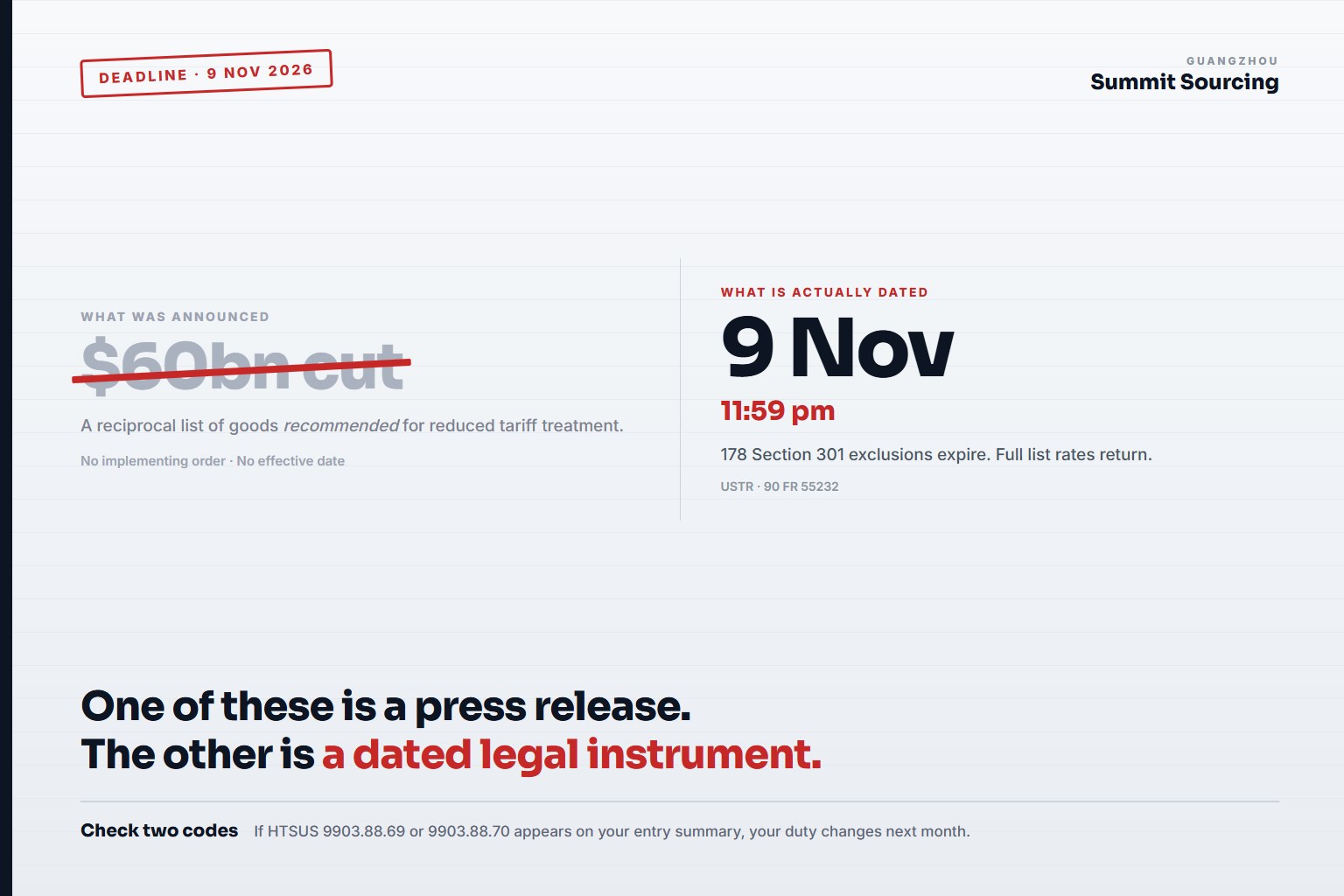
Neither should. That cut is a recommendation with no effective date attached to it. Meanwhile something that is already signed, dated and sitting in the Federal Register takes 178 tariff exclusions away at 11:59pm on 9 November, and almost nobody is writing about it.
So here is the gap between the headline and the paperwork, and what to do in the time left. Every section has a graphic if you would rather skim.
What actually happened on 27 September?
The White House published a list, not a tariff change. On 27 September 2026 it announced "a reciprocal list of U.S. and Chinese imports recommended for reduced tariff treatment", the so-called 30-for-30, covering 77 HTS lines into the United States and 1,619 into China (Thompson Hine SmarTrade, September 2026).
Read the verb. Recommended. There is no implementing order, no Federal Register notice and no effective date. The arrangement's own terms suggest tariffs under it will not be adjusted more than once a year, which tells you something about the pace to expect.
The categories on the US list are real enough and they are squarely ours: toys, electrical goods, miscellaneous consumer goods, food, medical equipment. If it lands, plenty of importers benefit. But you cannot plan an order around a rate that does not yet exist.
What is a Section 301 exclusion?
It is a carve-out that lets a specific product skip the Section 301 China tariff it would otherwise pay. There are 178 of them still alive, and importers claim them through HTSUS subheadings 9903.88.69 and 9903.88.70 (USTR, 90 FR 55232, December 2025).
Here is the awkward part. Plenty of importers are covered by an exclusion without knowing it, because their customs broker applies it quietly and the duty line simply comes back lower than expected. If you have never checked, you genuinely do not know whether 9 November is a non-event or a bad day.
That is the single reason I am writing this. Not because everyone is affected, but because the people who are affected mostly have not been told.
What happens at 11:59pm on 9 November?
The exclusion stops, and the underlying tariff comes back in full. The USTR notice extends the exclusions "through 11:59 p.m. eastern daylight time on November 9, 2026", with no taper and no stated grace period. Goods entered after that revert to the Section 301 rate for their list.
Those published list rates are 25 percent for Lists 1 to 3 and 7.5 percent for List 4A, and they stack on top of whatever ordinary duty your product already carries. A line that has been clearing at your normal MFN rate can jump by 25 points overnight.
How do I find out whether this hits me?
Three steps, and the first one takes a phone call. Pull a recent entry summary from your customs broker and look for HTSUS 9903.88.69 or 9903.88.70 on the duty lines. If either appears, you are claiming an exclusion today and it stops on 9 November.
If neither appears, you are already paying the full rate and the expiry changes nothing for you. That is genuinely good news in this one narrow sense: there is nothing to lose that you have not already lost.
What can you actually do before 9 November?
Less than the internet will tell you, and the honest options are narrow. You cannot apply for a new exclusion, because no request process is currently open. You cannot rely on the 30-for-30 list, because it has no date. What you can do is control timing, pricing and origin.
Why do the two stories point in opposite directions?
Because one is diplomacy and the other is administration, and they run on completely different clocks. A leaders' meeting produces a list in an afternoon. Changing an actual duty rate takes an implementing order, a Federal Register notice and a tariff schedule update, and until those exist nothing has moved.
The expiry works the other way round. It needs no announcement to happen. It was agreed a year ago, written down, and it executes on schedule unless somebody actively stops it. Silence favours the expiry and works against the cut.
This is the general rule I would take from the whole episode, and it applies well beyond this November: plan against what is dated, not against what is announced. A rate with a Federal Register citation is real. A rate in a press release is a hope with good PR.
What I am telling clients this month
Run the broker check this week, not in the first week of November. If an exclusion is in play, the useful question is not whether to panic but whether your Q1 pricing already assumes a duty rate that is about to stop existing.
For the two clients who sent me the headline: one turned out to have no exclusion on any of his lines, so the answer was simply to carry on. The other did, on a product that is most of his revenue, and he had been quoting 2027 prices to a retail buyer on the current duty. That second conversation was worth having in October rather than December.
And if the 30-for-30 cut does land later, good. Nothing in the check above is wasted, because you will have an accurate duty picture either way. That is the asymmetry worth acting on.
The one email to send today
To your customs broker: "Please confirm whether any of our entries in the last 12 months claimed HTSUS 9903.88.69 or 9903.88.70, and if so, what our duty rate becomes on those lines after 9 November 2026." That is the whole exercise.
Frequently asked questions
When exactly do the Section 301 exclusions expire?
The USTR notice extends them "through 11:59 p.m. eastern daylight time on November 9, 2026". So 9 November is the last day entries can claim them, and goods entered from 10 November pay the full Section 301 rate. No taper or grace period is stated in the notice.
Did the US and China actually cut tariffs in September 2026?
Not yet. On 27 September the White House published reciprocal lists of goods "recommended for reduced tariff treatment", covering 77 HTS lines into the US and 1,619 into China. No implementing order, Federal Register notice or effective date accompanied them, so no rate has changed.
How do I know if I am claiming an exclusion?
Check a recent entry summary for HTSUS subheadings 9903.88.69 or 9903.88.70 on the duty lines. Your customs broker can confirm in one reply. Many importers are covered without realising, because the broker applies it and the duty simply comes back lower.
Can I apply for a new exclusion before November?
No. There is no open exclusion request process at present. USTR began a second statutory four-year review in May 2026 and the continuation-request windows closed over the summer, but that is a separate process with no published date for its next phase.
How much will my duty go up?
It depends which Section 301 list your product sits on. The published list rates are 25 percent for Lists 1 to 3 and 7.5 percent for List 4A, applied on top of your ordinary MFN duty. Confirm your specific HTS line rather than assuming.
Should I rush an order in before the deadline?
Only if the goods can genuinely enter the US before 9 November. Sea freight from China rarely completes in under four weeks once production is included, so for most importers this window has already closed. Repricing is usually the more realistic response.
Key takeaways
- The $60bn "tariff cut" announced on 27 September is a list of recommendations with no implementing order and no effective date.
- 178 Section 301 exclusions expire at 11:59pm on 9 November 2026, under a USTR notice already on the books at 90 FR 55232.
- Check a recent entry summary for HTSUS 9903.88.69 or 9903.88.70. If either appears, your duty changes next month.
- No new exclusion process is open, and no grace period is stated. Timing, pricing and origin are the only levers left.
- The general rule: plan against what carries a Federal Register citation, not against what carries a headline.
Sources
- Office of the United States Trade Representative, "Notice of Product Exclusion Extensions: China's Acts, Policies, and Practices Related to Technology Transfer, Intellectual Property, and Innovation", Federal Register, 1 December 2025, citation 90 FR 55232, retrieved 2026-10-08, federalregister.gov
- Thompson Hine SmarTrade, "U.S.-China Board of Trade '30-for-30' Identifies Products Recommended for Reduced Tariffs", 29 September 2026, retrieved 2026-10-08, thompsonhinesmartrade.com
- The Section 301 list rates quoted here are the published rates for Lists 1 to 3 and List 4A. Duty outcomes depend on your specific HTS classification and on other measures that may apply, including ordinary MFN duty and any Section 232 tariffs.
- This article is general information about US trade procedure and is not customs or legal advice. Confirm your own position with a licensed customs broker before acting.
Not sure whether this touches your product?
Send us your product and HTS code. We will tell you what the duty picture looks like after 9 November, and whether a different origin or a different supplier changes the maths.
Get a free quote